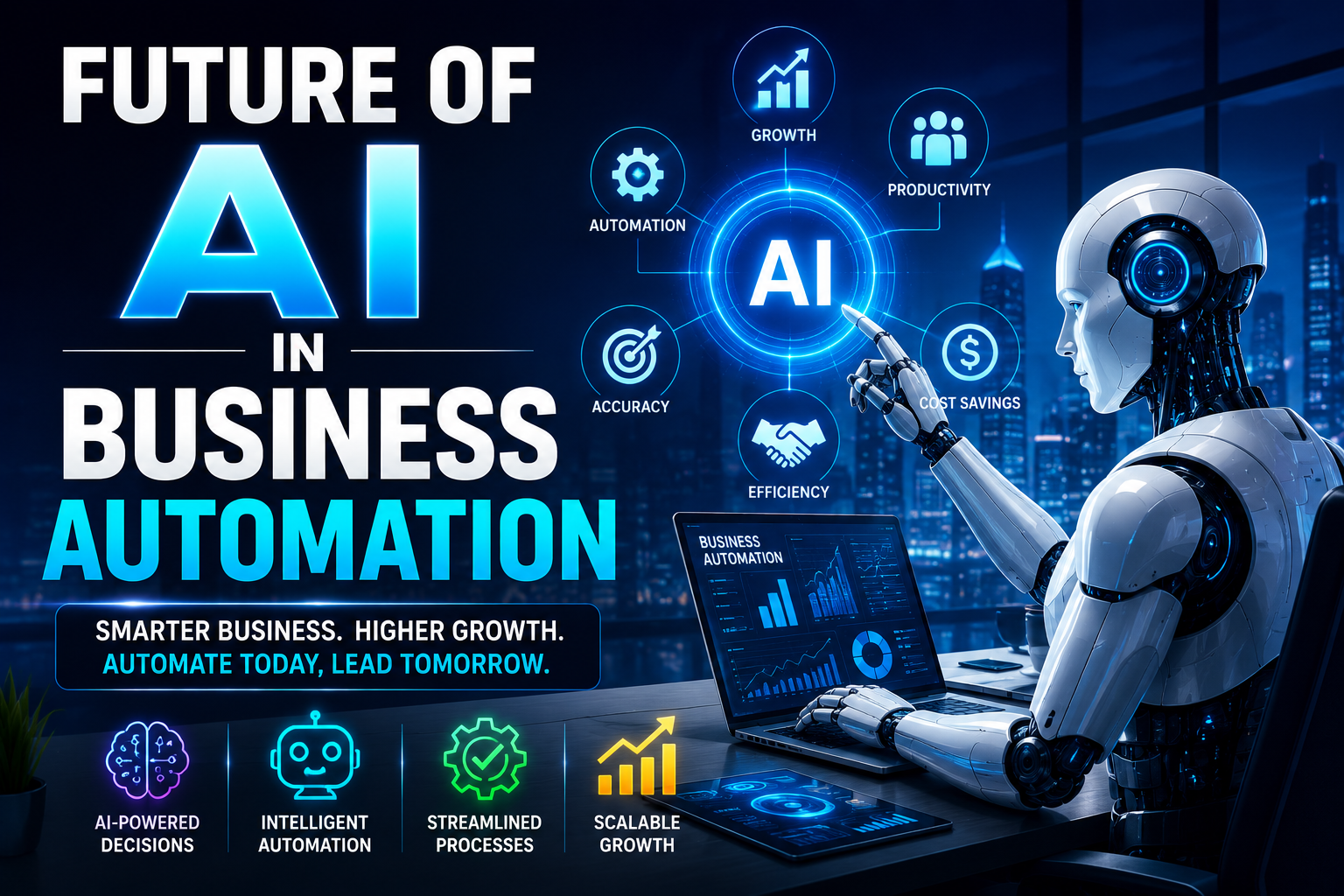
The future of AI in business automation is moving beyond simple rule-based tasks toward agentic, adaptive, and autonomous systems that can reason, collaborate, and continuously optimize. Here’s what that looks like in practical terms over the next 3–7 years.
1. From Robotic Process Automation (RPA) to Agentic Workflows
Today’s automation (e.g., invoice scanning, email triggers) is brittle – it breaks if a field changes.
Future: AI agents that understand intent, handle edge cases, and self-correct.
- Example: An agent not only reads a purchase order but also negotiates with a supplier via email, checks inventory in real time, and updates accounting – all without hardcoded rules.
2. Hyper-personalized customer operations
Chatbots will become full-context, emotional-aware digital employees that remember past interactions, tone, and even customer sentiment from voice.
- Impact: 70-80% of first-level support, sales qualifying, and retention calls fully automated.
- Businesses will move from “chatbot for FAQs” to AI-led relationship management – especially in banking, telecom, and e‑commerce.
3. Decision automation, not just task automation
AI will move from doing things for you to deciding what to do.
- Dynamic pricing – real-time adjustment based on competitor moves, weather, local events, and supply chain status.
- Supply chain self-healing – an AI detects a port strike, reroutes shipments, rebooks carriers, and updates customs docs within minutes.
- HR & finance – automatic overtime approvals, budget reallocations, and compliance checks embedded into every workflow.
4. Human-AI collaboration as the new operating model
The “fully lights-out” business is rare. Instead, expect co-pilot automation everywhere:
- Every manager will have an AI analyst that pre-drafts reports, highlights anomalies, and simulates “what if” scenarios.
- Employees will handle exceptions, creativity, and relationships; AI handles execution, monitoring, and data synthesis.
- Example: An auditor reviews a flagged transaction; AI has already traced the anomaly, drafted a memo, and suggested a control fix.
5. Generative AI for dynamic process creation
Instead of programming workflows, managers will describe desired outcomes in natural language.
- “Automate the employee onboarding process for remote hires in Germany” → AI generates forms, IT access steps, training assignments, and legal checklists.
- This turns business automation from an IT project into a self-service capability.
6. Challenges that will shape the timeline
| Challenge | How it will be addressed |
|---|---|
| Hallucinations in critical decisions | Layered architectures: small, deterministic models for numbers + guardrail LLMs for approvals. |
| Integration with legacy systems | API-generating AI that reads old code or screen-scrapes green‑screens and builds modern connectors. |
| Regulatory & auditability | “Explainable automation” – every AI action logs a natural-language justification and confidence score. |
| Job displacement anxiety | Shift to outcome-based roles – people become “automation supervisors” rather than data processors. |
Near-term roadmap (by 2028)
- 2025-2026: Widespread adoption of multimodal agents (text + voice + image) in back-office workflows like AP/AR, procurement, and HR case management.
- 2027: First fully autonomous “department” (e.g., an AI-led customer retention team) with a human manager overseeing performance KPIs only.
- 2028+: Real-time process mining + generative AI – systems that observe how work gets done, then suggest (or implement) optimizations without human prompts.
Bottom line for businesses
The future is not about replacing people with AI. It is about replacing rigid, repetitive processes with adaptive intelligence. Companies that win will:
- Map all business processes to identify which decisions can be delegated to AI.
- Invest in data plumbing – automation is only as good as the data it accesses.
- Train employees to become AI process designers, not just users.
“The next decade will treat business processes the way the cloud treated servers – as something you describe, not assemble.”
The rise of “autonomous agents” working in swarms
Instead of one AI doing everything, businesses will deploy teams of specialized agents that communicate, delegate, and check each other.
- Example: An e‑commerce company might have:
- Inventory agent – monitors stock, predicts reorder points, negotiates with suppliers.
- Pricing agent – adjusts prices in real time based on demand and competitor data.
- Returns agent – processes refunds, updates warehouse, triggers restock.
- Customer sentiment agent – scans reviews/social media for product issues.
These agents negotiate with each other: e.g., Pricing agent asks Inventory agent, “If I drop price by 10%, can you handle the volume?” This multi-agent orchestration is already in labs (AutoGen, CrewAI) and will be production-ready by 2026-2027.
2. Automation of knowledge work: from documents to decisions
Current OCR + RPA handles structured forms. The next leap is unstructured reasoning:
| Task | Today | Future (3-5 years) |
|---|---|---|
| Legal contract review | Keyword search + manual redlining | AI reads intent, flags risky clauses, suggests alternative language aligned with company policy |
| Financial forecasting | Spreadsheet models + monthly manual updates | AI continuously ingests macro data, competitor earnings, internal sales – updates weekly forecasts with explanations |
| Regulatory compliance | Annual audits + tick-box checklists | Real‑time monitoring of all transactions/communications; instant alert when a new regulation changes a requirement |
Key enabler: Long‑context LLMs (e.g., 1M+ tokens) that can ingest entire legal codes, product manuals, or historical audit trails in one pass.
3. Hyperautomation of customer journey touchpoints
Not just chatbots. AI will own entire micro‑journeys from start to finish, with handoffs only when the user explicitly asks for a human.
Example – Insurance claim:
- User uploads accident photos → AI assesses damage via computer vision.
- Compares to policy terms → determines coverage.
- Checks police database (via API) for report.
- Authorizes payment and sends to repair shop.
- Sends status updates via WhatsApp.
Human only if user disputes the damage assessment.
Leading insurers (Lemonade, Progressive) already do parts of this; future systems will handle 95%+ of simple claims fully autonomously.
4. The “invisible hand” of process mining + generative AI
Most companies don’t know how their processes actually run – only how they’re designed to run.
Future: AI continuously mines event logs from ERP, CRM, email, Slack, and automatically discovers bottlenecks, deviations, and opportunities.
- Example: AI notices that purchase approvals for office supplies often wait 4 days at a specific manager. It suggests: “Remove manager approval for orders under $500 (based on 12 months of data with zero fraud). Automate approval via Slack emoji.” Then implements the change through API calls to the workflow engine.
This turns automation from a project into a self-optimizing system.
5. Industry‑specific deep dives (where the real ROI will be)
| Industry | Killer automation use case | Timeline |
|---|---|---|
| Healthcare | Prior authorization + medical coding – AI reads doctor’s notes, codes diagnoses, submits to insurers, schedules follow-ups. | 2027 |
| Manufacturing | Predictive quality control – cameras + vibration sensors + LLMs to diagnose root causes of defects in natural language (“drill bit worn after 1200 cycles”). | 2026 |
| Logistics | Dynamic carrier selection with real‑time weather/port congestion – AI rebooks shipments automatically, recalculates ETA for customers. | 2025 |
| Banking | Anti‑money laundering investigation – AI traces suspicious transaction graphs, drafts SAR reports, flags only 1% for human review. | 2026 |
| Retail | End‑to‑end vendor negotiation – AI compares quotes, simulates counteroffers, signs NDAs, and places POs. | 2028 |
6. What will not be automated anytime soon (the human moat)
Even with advanced AI, certain activities will remain human-led for the next 10+ years:
- High‑stakes creative direction (brand identity, product vision, artistic campaigns)
- Empathetic crisis handling (layoffs, customer trauma, PR disasters)
- Negotiations involving personal relationships or trust (B2B enterprise sales, union talks)
- Ethical judgment calls with no clear precedent (“Should we enter this market despite human rights concerns?”)
Businesses that try to automate these will fail. The smart ones will build AI‑assisted human teams for these areas.
7. Economic & workforce shifts you need to plan for
| Shift | Implication |
|---|---|
| Cost per automation unit drops near zero | Even small businesses will automate processes that once required six‑figure software deals. |
| The “supervised automator” job category | New role: process engineer + prompt engineer + exception handler. Expect 20‑30% pay premium over traditional data entry. |
| Outsourcing arbitrage disappears | If AI can process invoices in the US for $0.01 each, offshore labor arbitrage collapses. Focus shifts to language/cultural nuance. |
| Subscription-based process marketplaces | Companies will buy pre‑built “automation templates” for common workflows (e.g., GDPR compliance, employee onboarding) and customize with natural language. |
8. Practical steps to prepare your business today
If you want to be ahead of the curve by 2027, start now:
- Map your processes by “decision complexity” – simple rules (automate now), moderate judgment (augment with AI), high creativity/empathy (keep human, add copilot).
- Instrument everything – every click, email, approval timestamp. Without data, AI can’t optimize.
- Build a “failure budget” for automation – decide which mistakes are acceptable (e.g., 0.1% wrong invoice coding) vs. unacceptable (safety, legal).
- Train a team on agent orchestration – platforms like LangChain, AutoGen, or Microsoft AutoGen. This is the next SQL.
- Run a pilot in a non-critical but repetitive area – e.g., travel expense approval, IT ticket triage. Measure time saved and error rate vs. humans.
Final thought: Automation as a competitive weapon, not a cost saver
Most companies will stop at simple task automation. The winners will embed AI so deeply that their reaction time to market changes becomes measured in minutes, not weeks. They will launch products, adjust pricing, and respond to regulators faster than competitors who still rely on email chains and Monday meetings.