
In the sprawling third-floor hall of the Ministry of Finance’s North Block, where the air conditioning battles the June humidity and loses, a small plaque was unveiled last Thursday. It reads: “DBT 2.0 Mission Control — Samruddhi.” Behind it, a wall of screens displays, in real time, every direct benefit transfer moving from the Consolidated Fund of India to a citizen’s bank account. When the National Payments Corporation of India ran the first successful transaction under the new architecture on June 29 at 3:14 AM — a ₹2,647 nutrition supplement transfer to a pregnant woman in Nuapada, Odisha — the room reportedly broke into tired, relieved applause. It had taken fourteen months of eighteen-hour days to rebuild the engine of India’s cash transfer system from scratch, and the stakes are staggeringly high.The Ledger of Dignity: Unpacking the Samruddhi DBT 2.0 Mission, 2026
The Samruddhi Direct Benefit Transfer 2.0 Mission, approved by the Cabinet on May 15, is not a new scheme in the traditional sense. It is the largest back-end overhaul of the Indian welfare state since the introduction of the Public Distribution System in 1965. It does not announce a new pension or a new scholarship; instead, it takes 437 centrally sponsored and central sector schemes that involve any form of cash or near-cash transfer — scholarships, old-age pensions, maternity benefits, MGNREGA wages, fertiliser subsidies, PM-KISAN instalments, housing assistance, LPG cylinder subsidies — and funnels them through a single, AI-governed, privacy-shielded Direct Benefit Transfer pipeline. The total volume at stake is ₹7.8 lakh crore annually, equivalent to roughly 2.3% of India’s projected GDP for 2026–27. The mission’s tagline, printed on the internal training manuals, is deceptively simple: “Right person, right amount, right time, zero leakage, zero paperwork, zero humiliation.”
But to understand what Samruddhi really means — for the widow in Azamgarh, the landless labourer in Kanniyakumari, the transgender beneficiary who has never been able to open a bank account without a battle — we must go beyond the dashboards and into the grit of architecture, the moral dilemmas of algorithmic exclusion, and the quiet rebellion of digital literacy movements that are, even as I write, determining whether this mission becomes a liberation or another layer of digital gatekeeping.
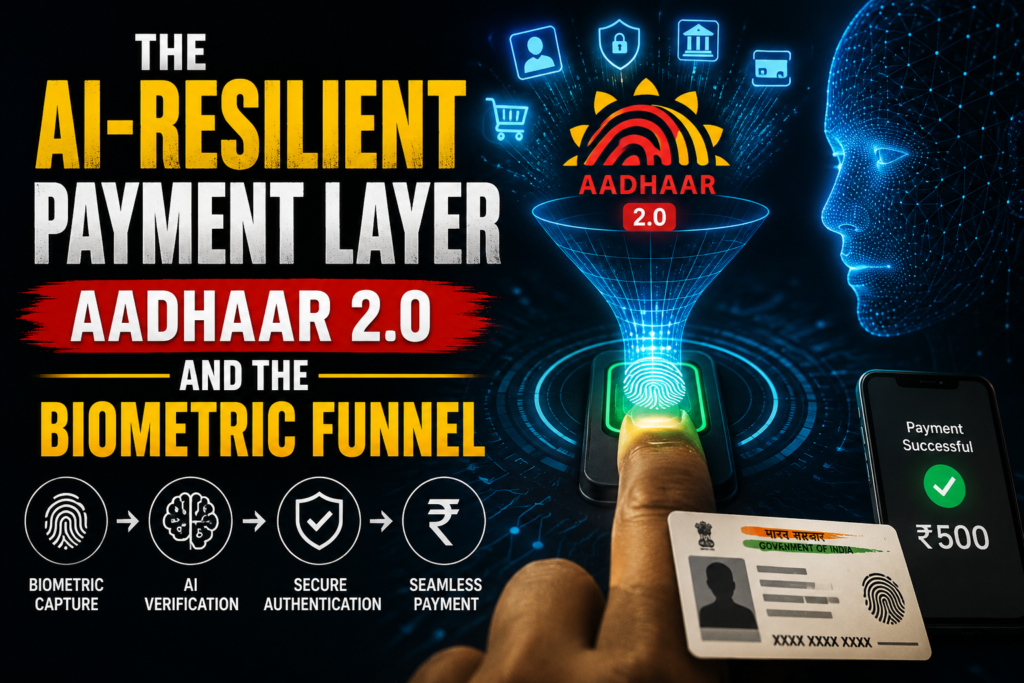
Pillar 1: The AI-Resilient Payment Layer — Aadhaar 2.0 and the Biometric Funnel
The original JAM (Jan Dhan-Aadhaar-Mobile) trinity, celebrated globally since 2014, had undeniably remarkable successes. By 2025, over 52 crore Jan Dhan accounts were seeded with Aadhaar, and the Aadhaar Payment Bridge System was processing over 12 crore DBT transactions a month. The World Bank, in a cautiously worded 2024 report, estimated that the government saved ₹3.48 lakh crore between 2014 and 2024 through the elimination of ghost beneficiaries and middlemen.
But beneath the macro euphoria, a parallel set of failures had accumulated to a breaking point. A 2025 Parliamentary Standing Committee on Finance report, tabled just before the general election, identified four systemic fractures. First, payment failure rates due to name mismatches between Aadhaar and bank records, dormant accounts, and NPCI mapper errors had plateaued at an unacceptable 7.3%, meaning that every year, roughly ₹57,000 crore in intended benefits either returned to the government or got stuck for months. Second, the DBT architecture was not built for biometric authentication failures among manual labourers, the elderly, and leprosy-affected individuals whose fingerprints simply do not register on the substandard scanners deployed at fair price shops and bank mitras. Third, the systems for grieving a failed transaction were fragmented across scheme-specific portals, leaving a beneficiary to navigate the MNREGA ombudsman for wage loss and a separate bank grievance officer for a failed scholarship. Fourth, and most troublingly from a civil liberties perspective, the absence of a consent layer meant that a citizen’s entire subsidy trail — what she bought with her PAHAL gas subsidy, when she withdrew her pension, where her child’s scholarship money was spent — was visible across multiple government departments with no data purpose limitation.
The final trigger for the Samruddhi Mission was not a CAG report but a series of hunger deaths in Baran district, Rajasthan, in the summer of 2025. An investigation by the Rajasthan High Court’s legal services committee found that 11 Adivasi families entitled to the National Food Security Act’s cash-in-lieu-of-food-grains transfer had not received their DBT for seven months because their bank accounts had been deactivated after being incorrectly flagged as “dormant” during an automated bank system update. The money was there in the government’s treasury; the pipeline was broken. The families borrowed from a local moneylender at 10% per month, and when they could not repay, he confiscated their ration cards. One elderly woman, Sumitra Bai, told the visiting judge: “The government said money would come directly to my account. I never asked for it directly. I only asked that when it doesn’t come, someone listens.” Samruddhi is, at its core, an attempt to answer Sumitra Bai’s question.
Pillar 1: The AI-Resilient Payment Layer — Aadhaar 2.0 and the Biometric Funnel
The first technical transformation is the most radical and the most ethically fraught. Samruddhi abandons the old model where every DBT transaction required a real-time Aadhaar biometric authentication for withdrawal. Instead, it introduces a “risk-scored authentication” architecture designed by a consortium of the Indian Institute of Science, the International Institute of Information Technology Bangalore, and the National Institute of Public Finance and Policy.
The logic works like this: for a recurring benefit like an old-age pension or PM-KISAN installment that has been flowing to the same Aadhaar-seeded bank account for three years without a failure, the system performs a biometric authentication only once every six months during the “life certificate” update, and not at every withdrawal. The money arrives as a normal account credit that can be withdrawn through an ATM with a PIN, a UPI transfer, or a biometric micro-ATM, whichever the beneficiary prefers. For a new beneficiary, or for a high-value one-time transfer like PM Awas Yojana’s third instalment, a one-time face authentication via the Aadhaar Face RD app, which is being upgraded to work even with a ₹6,000 smartphone’s 2MP front camera in low-light conditions, is required. This layered approach reduces the points of failure from biometric scanners by an estimated 60%, but more importantly, it shifts the design principle from “always authenticate” to “authenticate only when the risk algorithm flags an anomaly.”
The “risk algorithm” itself is open-source, a demand that the Digital India Foundation and the Software Freedom Law Centre fought for relentlessly during the mission’s consultation phase. Built on a rules-based engine rather than a deep learning black box, it flags anomalies like a sudden change of bank account for a pensioner who has used the same account for six years, a mobile number that appears as a primary contact for 15 different beneficiaries, or a transfer attempted from an IP address in a different state than the beneficiary’s registered district. When flagged, the transaction is not blocked — a critical departure from the earlier Payment Failure Regime — but is instead moved to a “delayed queue” and the beneficiary receives an automated call in her registered language asking her to confirm the transaction or visit the nearest Common Service Centre for a one-time facial authentication. The design is reminiscent of how modern banks handle credit card fraud, and it acknowledges a fundamental welfare truth: a block harms the poor person far more than it costs the state, so delays with remediation are better than denials without recourse.
However, the biometric funnel is only as good as the biometric. For the estimated 2.7% of the adult population with severely worn fingerprints, the mission mandates the use of iris scans as the primary fallback, with all 1.6 lakh bank mitras and 5.5 lakh CSCs being equipped with iris scanners by March 2027. The rollout is behind schedule, partly because the lowest-cost iris scanner that meets UIDAI specifications costs ₹4,700, and the government’s subsidy to the vendors covers only ₹3,200. In Maharashtra’s Gadchiroli, a bank mitra told me she has been using her own savings to buy the scanner because “the tribal women labourers here lose their fingerprint texture during road construction work, and if I can’t authenticate them, they go home without wages, and I bear the brunt of their anger.” The economics of the last mile remain stubbornly human.
Pillar 2: The Unified Beneficiary ID — One Number to Receive All Entitlements
The second pillar is the “Samruddhi ID,” a single 12-digit beneficiary number that is deliberately not the Aadhaar number. It is a new, programme-specific ID that maps internally to the Aadhaar number in a tokenised, encrypted form, but is the only number that the beneficiary needs to present or quote to access any of the 437 schemes. The Samruddhi ID is seeded with Aadhaar during enrolment at a single registration point — an anganwadi centre, a school, a CSC — and then linked to the beneficiary’s chosen bank account, mobile number, and, with her explicit consent, her ration card number and UPI ID. The consent architecture is granular: a beneficiary can consent to her Samruddhi ID being used for all DBT schemes she is entitled to, or she can consent only to specific schemes, like the scholarship for her daughter, while opting out of any other scheme linkage.
The transformative potential lies in the auto-enrolment engine. The old DBT architecture was application-based: you had to know a scheme existed, find the right form, fill it, attach documents, and hope your application was processed before the deadline. In Samruddhi, the system uses pre-existing data from the Socio-Economic Caste Census (SECC), the National Food Security Act’s digitised ration card database, and the income thresholds from the Income Tax Department to auto-identify eligible beneficiaries and send them an SMS and a physical letter: “You appear eligible for the National Social Assistance Programme pension. If you wish to enrol, please visit the nearest enrolment point with your Samruddhi ID and bank passbook by [Date]. You do not need any other document.” This is not a flawless system — the SECC 2011 is notoriously outdated, and a new census is only beginning in late 2026 — but the principle is a fundamental reversal: the state seeks out the citizen instead of demanding the citizen prove her poverty.
There is, however, a quiet civil liberties battle around the Samruddhi ID that has not yet hit the op-ed pages. The ID’s tokenised link to Aadhaar means that a breach of the encryption keys, while technologically unlikely, would expose the entire subsidy profile of a citizen. The mission’s Data Protection Impact Assessment, conducted by the Centre for Internet and Society and published in full, states that the encryption standards are “quantum-resistant” and that any decryption request from a law enforcement agency will require a warrant from a judicial magistrate, not a self-authorisation by a joint secretary. But the Personal Data Protection Act, 2025, is still being implemented in phases, and the Data Protection Board’s technical capacity to audit the Samruddhi encryption is untested. Privacy advocates have called for the Samruddhi ID to be made entirely voluntary, with beneficiaries retaining the option to use individual scheme IDs. The government has agreed in principle, but the operational guidelines say this “opt-out” will be processed only upon written request to the district welfare officer — a level of bureaucratic navigation that essentially renders the opt-out theoretical for the non-literate.
Pillar 3: The Human Grievance Spine — Vidhik Mitra and the Real-Time Ombuds
The third pillar is a response to the Baran tragedy and to thousands of smaller, quieter tragedies. Samruddhi creates a single national DBT grievance system, the “Samruddhi Saathi,” that is legally designated as a quasi-judicial body under the Right to Timely Delivery of Services Act, 2025. Every district will have at least two “Samruddhi Saathis” — not call centre agents, but trained public facilitators who can initiate a transaction trace, call the NPCI mapper directly, and authorise a “human override” payment from a district-level contingency fund when a genuine, verified failure has caused acute distress. The district Saathi’s decision on a claim of up to ₹5,000 is binding and must be honoured by the bank within 48 hours, with the reimbursement coming later from the central scheme fund. For a larger claim, the Saathi makes a recommendation to a state-level ombuds, which must decide within 15 days.
The Saathi is also responsible for what the mission’s design document calls “adult guardianship support.” An estimated 11% of DBT beneficiaries, particularly elderly widows, differently-abled persons, and individuals with severe mental illness, are unable to operate their bank accounts independently and currently rely on a family member, often the same son or husband who may be withholding their money. Samruddhi introduces a formal “trusted guardian” appointment process where a beneficiary, in the presence of two witnesses and the Saathi, can designate a non-family member — an anganwadi worker, an SHG member, a neighbour — as an authorised agent to withdraw funds on their behalf, with a cap of 50% of the benefit per month and a mandatory biometric audit trail. This is a practical acknowledgment that financial autonomy is not a binary but a spectrum, and that for some of the most vulnerable women, protection from familial financial abuse requires a state-brokered, community-witnessed safe withdrawal mechanism.
I spent an afternoon with a Saathi in Sikandarpur, a block in Ballia, Uttar Pradesh, last week. His name is Rajkumar, previously a bank mitra, now in a khaki uniform with a tablet. He had just resolved a case where a widow’s pension had been deposited, but the bank had deducted ₹470 as “account maintenance charges” because the minimum balance had fallen below ₹500, reducing the pension to ₹1,530. Rajkumar called the bank’s nodal officer, pointed out that under a 2019 RBI circular, basic savings accounts for DBT beneficiaries cannot have minimum balance requirements or any charges, and the amount was reversed within three hours. The widow, Dhania Devi, eighty years old and blind, held his hand and said, “The bank people never listen. You listened. The money is back.” The Saathi model, if it works at scale, could become as important a welfare institution as the anganwadi worker, but it depends entirely on the quality of recruitment and the protection of Saathis from political pressure. The scheme allocates ₹1,800 crore for the Saathi network over three years, with a maximum of one Saathi per 8,000 beneficiaries, which is lean but functional if the technology layer actually reduces the caseload of preventable failures.
Pillar 4: The Transition from In-Kind to Cash — Fertilisers, Food, and the Volatility Hedge
The most politically combustible component of Samruddhi is not the technology but the quiet shift from in-kind subsidies to direct cash. The mission incorporates a “phased nutrient-based cash transfer” for fertilisers, building on the pilot that ran in 16 districts in 2024–25. Instead of the government paying the fertiliser manufacturer directly and the farmer getting a subsidised bag at a fixed price, the farmer will now receive a per-acre cash transfer into her Samruddhi-linked bank account, equivalent to the subsidy amount for the recommended dosage of urea, DAP, and potash, based on her digitally recorded land records and the crop she has sown. She is then free to buy fertiliser from any dealer, at market price, using that cash. The objective is to break the decades-old nexus of diversion, where subsidised urea meant for Indian farms ends up in factories in Nepal and Bangladesh, and to empower the farmer to choose fertiliser based on soil health rather than political pricing. The transition is scheduled to cover 40% of urea consumption by March 2027 and 100% by March 2029.
The farmers’ unions are split. The Bharatiya Kisan Union (Arajnaitik) has welcomed the move, arguing that the old system made the farmer a supplicant at the dealer’s shop, waiting for a subsidised bag that was often sold in the black market anyway. But the Rashtriya Kisan Mahasangh, influential in western Uttar Pradesh, has raised two serious objections. First, the cash transfer is calculated based on the average state-level price of fertiliser, but if a farmer in a remote area has to pay a higher price because of transportation costs, the transfer will not cover her actual cost. Second, and more fundamentally, the shift to cash exposes the farmer to price volatility. If an international supply shock — a natural gas price spike, a trade disruption — drives up fertiliser prices by 40% in a single season, the government’s predetermined cash transfer will be insufficient, and the small farmer, who is also the most price-sensitive, will under-apply nutrients, reducing her yield. The mission’s answer is a “price stabilisation fund” of ₹15,000 crore that will automatically trigger a top-up transfer if the All India Average Fertiliser Price Index rises more than 10% in a quarter. But the top-up is based on a quarterly index; a farmer who buys her fertiliser in the first week of the quarter when prices have just spiked will have to wait up to three months for the top-up, a cash flow gap that a subsistence farmer simply cannot bridge. The Ram Manohar Lohia Institute in Lucknow has already started a study on the optimal frequency of price indexation, and the initial recommendation is to move to a monthly index, but the government’s fiscal managers are resisting the administrative cost.
The same cash transition logic applies to the Public Distribution System. Samruddhi does not abolish PDS — the political backlash would be suicidal — but it introduces a “cash or grain” choice for 60% of the beneficiaries in urban areas and 30% in rural areas in the first phase. A beneficiary who opts for cash gets the NFSA entitlement amount (currently ₹22 per kg for wheat and ₹18 per kg for rice as the economic cost, with the subsidy making up the difference between that and the ₹2/₹3 issue price) transferred directly to her account, and she can buy grain from any FCI-licensed or open-market retailer. The voucher code is non-transferable and expires at the end of the month, and the redeemed grain bags are tracked through blockchain-based weighment data from the FCI godowns to the retailer. The pilot in Chandigarh and Pondicherry in 2025 had an 81% satisfaction rate, with women reporting that the ability to buy grain in smaller, more frequent quantities instead of a heavy monthly bag improved their cash management. But the danger is that the cash, once in the account, can be diverted by an alcoholic husband before the grain is bought. The scheme tries to address this with a “grain wallet” feature — the cash is ring-fenced in a wallet that can only be redeemed at licensed food retailers, not withdrawn as general cash — but the wallet is only compatible with a smartphone app at present, excluding the very women who rely on basic feature phones. The ministry says a USSD-based (*99#) wallet interface is being developed and will be piloted in October, but such promises have a way of remaining promises.
Pillar 5: The Universal Basic Income Pilot — A Tentative Step into Uncharted Waters
The most quietly radical element of Samruddhi, buried in Chapter 12 of the Annexures, is the “Anubandh Basic Income Pilot.” In twelve of India’s 112 aspirational districts — chosen for their extreme poverty and high Adivasi or Dalit populations — every household will receive an unconditional monthly cash transfer of ₹6,000, totalling ₹72,000 per year, for a period of 36 months, starting January 2027. The pilot will cover approximately 2.1 lakh households, roughly 9 lakh individuals, with a total allocation of ₹1,944 crore per year. The pilot is designed as a randomised control trial with a pure control group, a treatment group that receives the cash, and a “plus” treatment group that receives the cash along with a dedicated financial literacy and livelihood support counsellor. The evaluation, contracted to the Institute for Financial Management and Research and the Abdul Latif Jameel Poverty Action Lab, will measure changes in consumption, health, education enrolment, women’s decision-making power, and, critically, the labour market participation rate, which is the eternal fear of UBI sceptics.
The political architects of the pilot have been careful to frame it not as a universal basic income, which remains a toxic term in a country where the middle class equates “free cash” with laziness, but as a “consolidated poverty elimination grant” that replaces all other fragmented cash transfers in the pilot area. A household receiving the Anubandh grant will not also receive PM-KISAN, old-age pension, or MGNREGA wages — the grant is in lieu of all of them. This simplification is the true experiment: can a single, dignified, unconditional transfer, unaccompanied by the paperwork and biometric humiliation of a dozen small schemes, actually lift households out of the poverty trap more effectively than the targeted, conditional, fragmented architecture of the last seven decades?
The early signals from the baseline survey, conducted in May 2026, are telling. In the pilot blocks of Baran (Rajasthan), Dantewada (Chhattisgarh), and Jamui (Bihar), researchers found that families were spending an average of 14 hours per month and ₹370 in travel and lost wages simply to access their existing schemes — standing in line at the PDS shop, visiting the bank mitra for MGNREGA wages, going to the panchayat office for a scholarship form. That’s ₹370 a month spent to receive an average of ₹2,100 in benefits, a 17.6% transaction cost. If Anubandh can eliminate that cost entirely, the effective value of the transfer is already 17.6% higher before the amount is even counted. A tribal woman in Dantewada, when asked by the survey team what she would do with the monthly ₹6,000 if she didn’t have to spend her days in queues, said: “I would plant a small vegetable garden behind my hut and sell the extra in the weekly market. But I don’t have the time now because I am always chasing my ration.” If the pilot data bears out her intuition, it could fundamentally alter the political economy of Indian welfare.
The Surveillance Question: Who Watches the Watcher?
For all its benevolent architecture, Samruddhi creates the most granular real-time database of citizen economic behaviour in human history. The transactions of 7.8 lakh crore rupees, the biometric authentication logs of half a billion people, the consumption patterns of every subsidised grain purchase, the geo-location of every withdrawal — all of it flows into the Samruddhi data lake. The mission’s Data Governance Policy, published as a draft for public comment until July 31, states that “no personal data shall be used for any purpose other than the delivery of benefits and the auditing of such delivery, without the informed, specific, and revocable consent of the data principal.” It further states that the data will not be shared with law enforcement agencies for preventive policing or profiling under the Bharatiya Nagarik Suraksha Sanhita without a judicial order. But the experience of the last decade has taught us that the gap between a draft policy and street-level reality is wide. In 2024, the Unique Identification Authority of India acknowledged, in response to a Right to Information request, that it had received 1,287 requests for Aadhaar authentication logs from police departments between 2021 and 2023, and had provided data in 1,012 cases, mostly without a judicial warrant, under the ambiguous “national security” exception in the Aadhaar Act.
The Information Commissioner has already written to the Finance Ministry, demanding that the Samruddhi Data Governance Policy be given statutory backing through a separate provision in the upcoming Digital India Act, 2026, rather than resting on an executive order. Civil society groups have called for a “Samruddhi Data Access Panel,” an independent body composed of former judges, technical experts, and civil liberties lawyers, to audit every police data request and publish an annual transparency report. The government, for now, has only said it will “examine the feasibility,” a phrase that often translates to indefinite deferral.
The Ground Check: What Determines Success
A scheme’s success is measured not in crore rupees but in the quiet moments when a citizen’s trust is either built or broken. Last week, I sat in a one-room house in Bhadohi district, the carpet-weaving belt of Uttar Pradesh, with a family of weavers. The patriarch, Hiralal, seventy-two, had been receiving an old-age pension of ₹1,200 under the old system, but it had stopped coming in March. He had made four trips to the bank, 12 kilometres away, each time spending ₹80 on a shared auto, and each time being told that his account was “under verification.” His daughter-in-law, Suman, a thin woman with steady eyes, had just received her Samruddhi ID card, and her son’s scholarship had been auto-enrolled and credited on July 1 without any paperwork. Hiralal, watching the commotion around the card, said: “Will this new thing bring my pension back? Or will it just give me another card and another queue?” Suman answered, not the officer but her father-in-law: “Babuji, the new thing is supposed to stop the queue. Let’s see.” She looked at me. “Come back in six months and see if the queue is still there.”
That is the only metric that matters. The Samruddhi DBT 2.0 Mission has the architecture to fundamentally reshape the relationship between the Indian state and its most vulnerable citizens, from one of supplication and filtering to one of proactive delivery and dignity. But architecture is not habitation. The warmth and responsiveness of the Saathi, the reliability of the iris scanner, the humility of the algorithm when it flags a false anomaly, the courage of the woman who demands her land records be linked to her own Samruddhi ID and not her husband’s — these human intangibles will fill the scaffold with life or leave it as an elegant, empty monument to a technocratic dream. Sumitra Bai of Baran died five months before the Samruddhi mission was approved. The question is whether the next Sumitra Bai, somewhere in a drought-hit taluka, will find that when she walks to the bank, the machine recognizes her not as a biometric exception but as a human being to whom the state has made a promise it intends to keep.