Introduction
Employment is one of the most important pillars of India’s economic growth. With a large young population entering the workforce every year, creating new jobs and bringing workers into the formal employment system has become a major priority.🇮🇳 PM Viksit Bharat Rozgar Yojana (PM-VBRY):
To encourage employment generation and support young people entering the formal workforce, the Government of India introduced the Pradhan Mantri Viksit Bharat Rozgar Yojana (PM-VBRY).
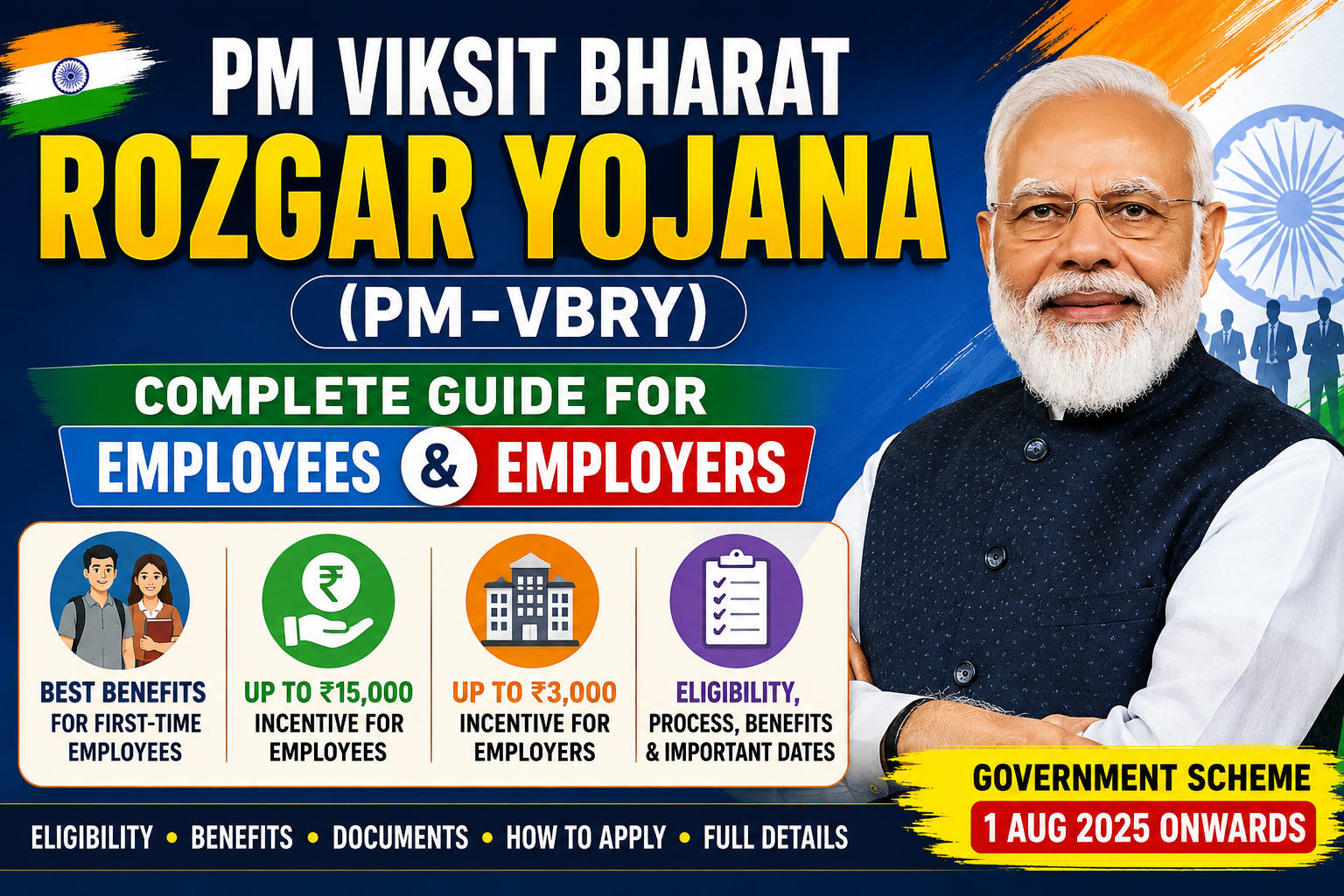
The scheme was originally approved as the Employment Linked Incentive (ELI) Scheme and is designed to encourage both employees and employers. First-time employees can receive an employment-linked incentive of up to ₹15,000, while eligible employers can receive incentives for creating additional employment.
The scheme applies to eligible employment created between 1 August 2025 and 31 July 2027. The government has allocated approximately ₹99,446 crore for the scheme and has set a target of encouraging more than 3.5 crore jobs over the two-year period. Around 1.92 crore first-time employees are expected to benefit from the scheme.
This article explains PM-VBRY in detail, including its objectives, eligibility, benefits, employee incentives, employer incentives, EPFO requirements, payment process, registration, important conditions and precautions.
What Is PM Viksit Bharat Rozgar Yojana?
PM Viksit Bharat Rozgar Yojana (PM-VBRY) is an employment-linked incentive scheme of the Government of India designed to encourage the creation of new formal jobs.
The basic idea behind the scheme is simple: the government wants to encourage businesses to hire additional workers while also helping young people enter formal employment for the first time.
The scheme focuses on two major groups:
- First-time employees
- Employers creating additional employment
Eligible first-time employees can receive an incentive equivalent to one month’s EPF wage, subject to a maximum of ₹15,000. Eligible employers can receive an incentive of up to ₹3,000 per additional employee per month, subject to the scheme’s conditions.
Therefore, PM-VBRY is not simply a cash assistance scheme. Its broader objective is to create a connection between new employment, formalisation and social security.
When Was PM-VBRY Launched?
The government approved the Employment Linked Incentive Scheme in 2025, which was subsequently introduced as PM Viksit Bharat Rozgar Yojana.
The scheme’s employment window began on 1 August 2025 and will continue until 31 July 2027.
During this period, eligible jobs created by qualifying establishments can come under the incentive framework.
The government has also established digital systems for implementation, including processes involving EPFO and Aadhaar-based authentication.
Main Objectives of PM-VBRY
PM-VBRY has several important objectives.
1. Creating New Employment
The primary objective is to encourage companies and establishments to create additional jobs.
The government has set an ambitious target of supporting more than 3.5 crore jobs during the scheme period.
This makes employment generation one of the central pillars of the programme.
2. Supporting First-Time Employees
For many young people, getting their first formal job can be difficult.
Employers may prefer candidates with previous experience, while young graduates and other first-time job seekers often struggle to enter the formal workforce.
PM-VBRY aims to encourage this transition by providing an incentive to eligible first-time employees.
3. Increasing Formal Employment
A large number of workers in India are employed in the informal sector.
Formal employment can provide workers with access to statutory benefits and social security systems such as EPFO.
PM-VBRY therefore aims to encourage more workers to become part of the formal employment ecosystem.
4. Expanding Social Security Coverage
Formal employment can help employees gain access to employment-linked social security benefits.
By connecting new workers with EPFO-covered establishments, the scheme can help expand social security coverage among India’s workforce.
5. Encouraging Employers to Hire
The scheme also provides incentives to eligible employers who create additional employment.
This is intended to reduce some of the financial burden associated with expanding the workforce and encourage businesses to make new hiring decisions.
Benefits for First-Time Employees
One of the most discussed features of PM-VBRY is the incentive available to eligible first-time employees.
Under the employee component, an eligible first-time employee can receive an incentive equivalent to one month’s EPF wage, subject to a maximum of:
₹15,000
However, it is important to understand that ₹15,000 is the maximum incentive, not a guaranteed payment for every person joining a job.
The actual incentive depends on the employee’s eligible EPF wage and compliance with the scheme’s conditions.
The incentive is also linked to continued employment.
The first instalment can be up to ₹7,500 after completion of six months of continuous employment, subject to the applicable conditions.
The remaining amount is provided later after the relevant eligibility requirements are fulfilled.
Who Is a First-Time Employee?
A first-time employee generally refers to a person entering eligible formal employment for the first time and meeting the conditions specified under the scheme.
This can include young people who:
- Have completed their education and are starting their first formal job.
- Are joining an EPFO-covered establishment for the first time.
- Are entering the formal workforce.
- Meet the applicable wage and other eligibility requirements.
Simply getting a new job does not automatically guarantee the incentive.
The employee, establishment and employment must meet the applicable PM-VBRY and EPFO requirements.
Is ₹15,000 Guaranteed to Every New Employee?
No.
This is an important point because several misleading claims about government schemes circulate online.
PM-VBRY does not mean that every person who gets a new job will automatically receive ₹15,000.
The government describes the employee benefit as an incentive equivalent to one month’s EPF wage, subject to a maximum of ₹15,000.
Therefore, the actual benefit depends on the employee’s eligible wage and other conditions.
The incentive is also linked to continued employment and other compliance requirements.
People should therefore avoid websites or social media posts claiming that every unemployed person can directly apply for ₹15,000 under PM-VBRY.
Benefits for Employers
PM-VBRY is different from schemes that focus only on individual beneficiaries.
It also provides incentives to eligible employers who create additional employment.
An eligible employer can receive up to:
₹3,000 per additional employee per month
subject to the applicable conditions.
The purpose of this incentive is to encourage employers to expand their workforce and retain additional employees.
This can be particularly relevant for businesses that are planning expansion and need to hire new workers.
Why Is the Employer Incentive Important?
Hiring a new employee involves several costs for a business.
These can include:
- Salary
- EPF contributions
- Recruitment expenses
- Training
- Administrative costs
- Workplace infrastructure
- Employee benefits
An employment-linked incentive can help reduce some of the additional cost associated with expanding the workforce.
The broader objective is to encourage businesses to create genuine, sustained employment rather than short-term hiring.
Special Focus on the Manufacturing Sector
The government has placed particular emphasis on the manufacturing sector under the employment incentive framework.
Manufacturing has significant potential for large-scale employment generation.
India’s manufacturing sector includes industries such as:
- Textiles
- Electronics
- Automobile manufacturing
- Food processing
- Pharmaceuticals
- Engineering
- Consumer goods
- Industrial production
Supporting employment in manufacturing can also contribute to broader economic goals such as increased production, investment and industrial development.
Role of EPFO in PM-VBRY
The Employees’ Provident Fund Organisation (EPFO) plays an important role in the implementation of the scheme.
Because PM-VBRY focuses on formal employment, EPFO-related employment and contribution records are important for determining eligibility and processing incentives.
Employees joining eligible establishments may need to have their employment and EPFO records correctly maintained.
This makes it important for employees to ensure that their UAN and employment information is accurate.
Aadhaar Authentication and Direct Benefit Transfer
Digital verification is an important part of the scheme.
Government information has referred to Aadhaar-based authentication, including Aadhaar Face Authentication, as part of the implementation process.
Direct Benefit Transfer, or DBT, is also used for transferring eligible incentives to beneficiaries.
Employees should therefore make sure that their relevant identification and bank information is accurate.
Important details can include:
- Aadhaar information
- UAN
- Bank account details
- Mobile number
- EPFO employment information
Incorrect information can potentially create difficulties during verification or payment processing.
Who Can Be Eligible for PM-VBRY?
Eligibility depends on whether the person is an employee or an employer.
For employees, some of the key requirements include:
- Joining eligible employment during the specified scheme period.
- Meeting the definition of a first-time employee where applicable.
- Being employed by an eligible establishment.
- Meeting the applicable EPFO requirements.
- Meeting the applicable wage criteria.
- Completing the required employment period.
- Meeting Aadhaar and payment-related requirements.
Government information has indicated that eligible new employees can have wages of up to ₹1 lakh per month, subject to the scheme’s detailed rules.
However, meeting the salary limit alone does not guarantee eligibility.
All applicable conditions must be satisfied.
Employer Eligibility
Employers must also satisfy specific requirements to receive benefits.
An establishment generally needs to create eligible additional employment and comply with applicable EPFO requirements.
The employer must be able to demonstrate that genuine additional employment has been created.
The employees for whom incentives are claimed must also satisfy the relevant scheme conditions.
Therefore, PM-VBRY is fundamentally an employment creation incentive, rather than a simple government subsidy available to every business.
PM-VBRY Scheme Period
The employment window for PM-VBRY is:
1 August 2025 to 31 July 2027
Eligible employment created during this period can qualify under the scheme, subject to all applicable requirements.
This means that PM-VBRY is not an unlimited permanent benefit for every new employee hired in India.
The employment date and other conditions are important for determining eligibility.
₹99,446 Crore Financial Outlay
The government has allocated approximately ₹99,446 crore for PM-VBRY.
This large financial commitment demonstrates the scale of the government’s employment-generation strategy.
The funds are intended to support incentives for both eligible first-time employees and employers creating additional employment.
The ultimate goal is to encourage large-scale formal job creation.
Target of More Than 3.5 Crore Jobs
One of the most significant targets of PM-VBRY is to encourage the creation of more than:
3.5 crore jobs
during the scheme period.
Around 1.92 crore first-time employees are expected to be included within the overall target.
If achieved successfully, the programme could bring a large number of young workers into formal employment.
This could have wider benefits for household income, savings, social security and long-term economic participation.
Why Is PM-VBRY Important for Young People?
India has one of the world’s largest young populations.
Every year, millions of young people enter the labour market.
For these workers, the first formal job can be extremely important.
A formal job can provide:
- Regular income
- Employment experience
- EPF-related benefits
- Social security coverage
- A formal employment record
- Better future career opportunities
- Greater financial stability
Therefore, the importance of PM-VBRY goes beyond the maximum ₹15,000 employee incentive.
Its larger objective is to help young workers enter and remain in the formal workforce.
Example: How the Employee Incentive Works
Consider a young person who gets their first eligible formal job at a qualifying establishment.
If the person meets the first-time employee criteria and all other conditions are satisfied, they may become eligible for an incentive equivalent to one month’s EPF wage, subject to the ₹15,000 maximum.
After completing the required period of continuous employment, the first instalment can be up to ₹7,500.
The remaining amount can be provided after the relevant conditions are fulfilled.
This structure encourages employees not only to obtain employment but also to remain in employment for the required period.
Can an Unemployed Person Directly Apply for ₹15,000?
No.
PM-VBRY should not be confused with a general unemployment allowance.
A person cannot simply apply as an unemployed individual and automatically receive ₹15,000.
The incentive is linked to eligible formal employment.
Therefore, the basic process is:
Eligible employment → fulfilment of conditions → verification → incentive
rather than:
Unemployment → application → ₹15,000
This distinction is extremely important.
How to Register for PM-VBRY?
The government has established digital systems and an official portal for implementation of the scheme.
Employees and employers should use only official government and EPFO channels for registration, verification and other scheme-related activities.
Applicants should be extremely careful about fake websites and fraudulent messages.
Never share sensitive information such as:
- OTP
- UPI PIN
- ATM PIN
- Internet banking password
- EPFO password
- Aadhaar OTP
with unknown individuals.
Government schemes are frequently targeted by online fraudsters who use fake registration forms and websites.
Importance of UAN
The Universal Account Number (UAN) is an important part of the EPFO ecosystem.
Employees entering formal employment should ensure that their employment records are correctly associated with their UAN.
If there are discrepancies in employment records, contribution information or personal details, employees should use official EPFO channels to resolve them.
Accurate records can help reduce problems during scheme verification.
What Employees Should Check
A person who believes they may be eligible should carefully check:
1. Employment Date
Check whether the employment falls within the PM-VBRY scheme period.
2. Employer Eligibility
The employer must be covered by the applicable scheme requirements.
3. First-Time Employment Status
The employee must meet the scheme’s definition of a first-time employee where applicable.
4. Wage Criteria
The employee’s wages must satisfy the applicable limits.
5. EPFO Details
UAN and employment records should be correct.
6. Aadhaar Details
The relevant Aadhaar authentication requirements must be completed.
7. Bank Account
Payment-related bank details should be accurate for DBT.
How Can PM-VBRY Affect India’s Economy?
The scheme can potentially influence India’s economy in several ways.
Increased Employment
More hiring can increase household income and consumer spending.
Formalisation
Workers can move from informal to formal employment.
Social Security
More employees can become connected with formal social security systems.
Business Expansion
Hiring incentives may encourage eligible companies to expand.
Productivity
Businesses with larger and more stable workforces can potentially increase production and productivity.
Youth Participation
More young people can enter the organised labour market.
Potential Benefits for MSMEs
Micro, Small and Medium Enterprises, commonly known as MSMEs, are major employment generators in India.
For businesses that qualify under the scheme, employment-linked incentives can make workforce expansion more attractive.
An MSME planning to increase production may need additional workers.
If the establishment satisfies the scheme’s requirements, the employer incentive can support the cost associated with additional employment.
This can potentially help businesses expand while creating more jobs.
Importance for the Manufacturing Industry
Manufacturing can create jobs across different skill levels.
A manufacturing facility may require:
- Machine operators
- Technicians
- Quality-control workers
- Supervisors
- Engineers
- Warehouse workers
- Logistics employees
- Administrative staff
Therefore, policies that encourage manufacturing employment can have a multiplier effect across related industries and local economies.
Women and PM-VBRY
Increasing women’s participation in formal employment is an important part of India’s broader workforce development goals.
PM-VBRY is not exclusively a women-focused scheme, but eligible women entering formal employment can benefit if they satisfy the scheme’s requirements.
Increasing formal employment among women can contribute to:
- Household income
- Financial independence
- Social security
- Career development
- Long-term savings
Businesses that create suitable employment opportunities can therefore play an important role in increasing workforce participation.
Rural Employment Opportunities
Employment generation is also important for India’s rural economy.
Manufacturing units, MSMEs and other eligible establishments operating outside major cities can potentially contribute to formal employment opportunities in smaller towns and rural areas.
However, PM-VBRY should not be described as a rural-only employment scheme.
It is a broader employment-linked incentive programme applicable according to its eligibility framework.
Common Misconceptions About PM-VBRY
Several misleading claims can circulate about government schemes.
Misconception 1: Everyone Gets ₹15,000
Incorrect.
₹15,000 is the maximum employee incentive, subject to eligibility and the applicable EPF wage.
Misconception 2: Unemployed People Can Apply Directly
Incorrect.
The benefit is linked to eligible formal employment.
Misconception 3: Every New Job Automatically Qualifies
Incorrect.
The employee, employer and employment must satisfy the applicable conditions.
Misconception 4: The Government Pays the Salary
Incorrect.
PM-VBRY is an incentive scheme; it does not replace the employer’s responsibility to pay the employee’s salary.
Misconception 5: Any Website Can Process the Application
Incorrect.
Applicants should rely only on official government and EPFO channels.
Important Precautions
Anyone interested in PM-VBRY should follow a few basic precautions.
Avoid Fake Registration Links
Do not click on suspicious links claiming to provide instant PM-VBRY benefits.
Do Not Pay Agents
Be cautious if someone demands money in exchange for guaranteed government benefits.
Never Share OTPs
Government officials and legitimate service channels should not require you to disclose sensitive OTPs to unknown people.
Verify Official Information
Always cross-check eligibility and payment information through official government sources.
Keep Records Updated
Ensure that UAN, Aadhaar and bank information are accurate.
PM-VBRY and the Vision of Viksit Bharat
The name of the scheme itself connects employment generation with the broader vision of a Viksit Bharat, or developed India.
A developed economy requires more than infrastructure and investment.
It also needs:
- Skilled workers
- Productive businesses
- Formal employment
- Social security
- Higher incomes
- Strong labour participation
- Opportunities for young people
PM-VBRY attempts to contribute to this objective by creating incentives around employment generation.
The idea is that businesses create jobs, workers enter formal employment and the economy benefits from greater participation and productivity.
Progress Under the Scheme
Government updates in 2026 have indicated that implementation and incentive distribution under PM-VBRY are underway.
The government has reported beneficiaries receiving employment-linked incentives and has continued to highlight the scheme as an important part of its employment-generation strategy.
The scale of implementation will ultimately depend on the number of eligible establishments, new employees, employment duration and compliance with the scheme’s conditions.
Therefore, official government updates remain the best source for current beneficiary and disbursement figures.
Conclusion
The PM Viksit Bharat Rozgar Yojana (PM-VBRY) is an important employment-linked incentive initiative of the Government of India.
Its central objective is to encourage the creation of new formal jobs while supporting people entering formal employment for the first time.
Eligible first-time employees can receive an incentive equivalent to one month’s EPF wage, subject to a maximum of ₹15,000. Eligible employers creating additional employment can receive an incentive of up to ₹3,000 per additional employee per month, subject to the scheme’s conditions.
The scheme covers eligible employment created between 1 August 2025 and 31 July 2027, with a total financial outlay of approximately ₹99,446 crore and a target of encouraging more than 3.5 crore jobs.
For young people, the most important aspect of PM-VBRY is not simply the incentive amount. Formal employment can provide a pathway toward EPFO-linked social security, employment experience, financial stability and better long-term career opportunities.
At the same time, employers can receive incentives for creating additional employment, making the programme a two-sided approach to employment generation.
However, people should remember that PM-VBRY is not a universal ₹15,000 cash scheme and not a general unemployment allowance. Eligibility depends on the employee, employer, employment date, wage criteria, EPFO requirements and other conditions specified under the scheme.
Anyone interested in the scheme should verify the latest rules through official government and EPFO channels and avoid fake websites, agents and fraudulent messages.
Overall, PM-VBRY represents an effort to connect employment generation, formalisation, social security and economic growth. If implemented effectively, it can help millions of young Indians enter the formal workforce while encouraging businesses to create additional jobs—supporting the broader goal of building a stronger and more developed Indian economy.