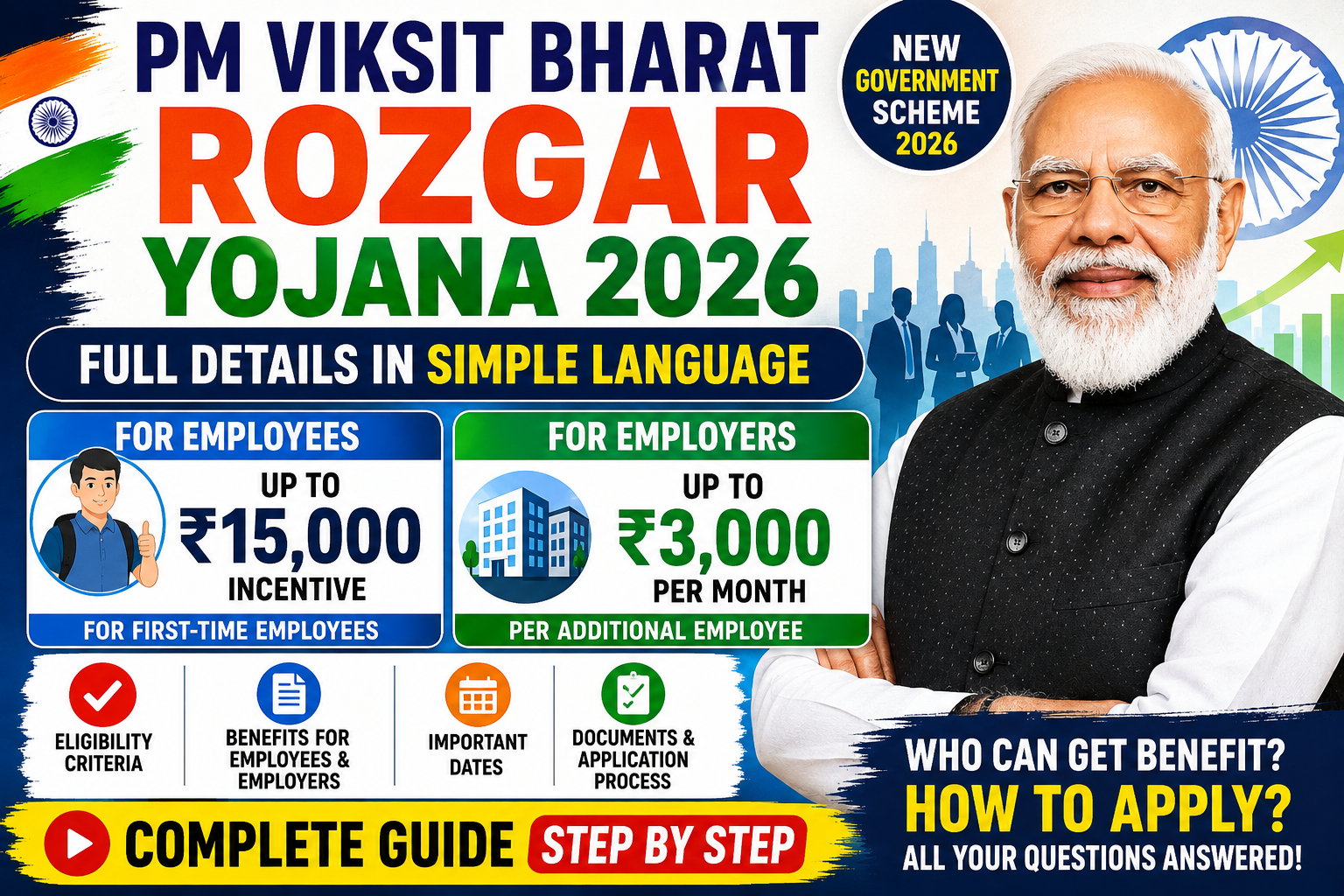
The Pradhan Mantri Viksit Bharat Rozgar Yojana (PM-VBRY) is one of the Government of India’s major employment-linked incentive schemes aimed at creating new formal jobs, supporting first-time employees, encouraging employers to hire additional workers, and expanding social-security coverage.PM Viksit Bharat Rozgar Yojana 2026 | Full Details in Simple Language
The scheme was originally announced as the Employment Linked Incentive (ELI) Scheme and came into effect as PM-VBRY from 1 August 2025. It applies to eligible jobs created between 1 August 2025 and 31 July 2027. The scheme has a total financial outlay of ₹99,446 crore and aims to incentivise the creation of more than 3.5 crore jobs over two years, including approximately 1.92 crore first-time employees entering the formal workforce.
The scheme is implemented by the Ministry of Labour and Employment through the Employees’ Provident Fund Organisation (EPFO). Its broader objective is to promote employment-led economic growth while helping more workers enter the formal employment system.
In simple words, PM-VBRY is designed to benefit both employees and employers. A person entering formal employment for the first time can receive an incentive of up to ₹15,000, while eligible employers can receive an incentive of up to ₹3,000 per month for each additional eligible employee.
What Is PM Viksit Bharat Rozgar Yojana?
PM Viksit Bharat Rozgar Yojana is an employment incentive programme created to encourage the generation of sustained formal employment in India.
The Government recognised that employment growth depends on two sides of the labour market. Employees need support when entering their first formal jobs, while employers need incentives to create additional positions and retain workers.
Therefore, PM-VBRY has two major components:
Part A – First-Time Employees:
This component provides a one-time incentive of up to ₹15,000 to eligible first-time employees joining the formal workforce.
Part B – Support to Employers:
This component provides financial incentives to eligible establishments that create additional employment and retain eligible employees for the required period.
The scheme also places special emphasis on the manufacturing sector because manufacturing can generate large-scale employment and strengthen India’s productive capacity.
Main Objectives of PM-VBRY
The scheme has several important objectives.
1. Create More Formal Jobs
One of the biggest objectives is to encourage businesses to create new formal employment opportunities.
Formal employment generally provides workers with greater access to systems such as provident-fund benefits and other forms of social security.
2. Support First-Time Employees
Starting the first job can involve several expenses and adjustments. PM-VBRY provides an incentive of up to ₹15,000 to eligible first-time employees.
3. Encourage Employers to Hire
Employers receive incentives for creating additional employment. This can reduce part of the financial burden associated with expanding their workforce.
4. Increase Social-Security Coverage
Because the scheme is linked with EPFO-covered employment, it is also intended to bring more workers into the formal social-security framework.
5. Encourage Long-Term Employment
The scheme is not simply designed around short-term hiring. Employers must satisfy the applicable conditions relating to additional employment and sustained employment.
6. Promote Manufacturing Employment
Manufacturing establishments can receive employer incentives for a longer period than establishments in other sectors, subject to the scheme’s eligibility conditions.
PM-VBRY Benefits for First-Time Employees
The first component of the scheme is particularly important for young people and other workers entering formal employment for the first time.
Eligible first-time employees can receive one month’s EPF wage, subject to a maximum of ₹15,000.
The benefit is structured in two instalments rather than being paid entirely at once. According to the scheme information, the first instalment becomes payable after completing six months of service, while the second instalment is linked to completing 12 months of service and completion of a financial-literacy programme.
This structure is intended to encourage employees not only to enter employment but also to remain in their jobs.
For example, suppose an eligible first-time employee has an applicable monthly EPF wage of ₹12,000. The incentive is based on the applicable wage under the scheme and is subject to the maximum limit of ₹15,000.
If the applicable amount is ₹15,000 or more, the maximum incentive under Part A remains ₹15,000.
It is important to understand that ₹15,000 is the maximum benefit, not a guaranteed payment for every employee.
Who Is a First-Time Employee?
The term “first-time employee” is important because Part A is specifically designed for people entering formal employment.
The scheme targets first-time employees who become registered under EPFO and meet the applicable conditions.
Therefore, simply getting a new job does not automatically mean that a person will receive ₹15,000.
The employee and employment must satisfy the conditions prescribed under PM-VBRY.
Employees should also ensure that their EPFO/UAN records, Aadhaar-related requirements and bank details are properly maintained wherever required for processing the benefit.
Salary Limit for Employees
Under the scheme, employees with monthly wages up to ₹1 lakh are within the applicable wage ceiling for the scheme.
However, the actual benefit depends on the scheme rules and the applicable EPF wage.
The ₹1 lakh figure should therefore not be confused with the ₹15,000 incentive.
In simple terms:
- ₹1 lakh is the relevant monthly salary/wage ceiling for eligibility under the scheme.
- ₹15,000 is the maximum first-time employee incentive.
- The employee does not automatically receive ₹15,000 simply because their salary is below ₹1 lakh.
The exact eligibility and payment depend on the official scheme conditions and EPFO records.
How Is the Employee Incentive Paid?
PM-VBRY does not treat the first-time employee incentive as an ordinary monthly salary payment.
The benefit is linked to continued employment.
The first instalment is payable after six months of service. The second instalment is payable after completion of 12 months of service along with completion of the prescribed financial-literacy requirement.
A portion of the incentive is also intended to encourage saving by being placed in a savings instrument or deposit arrangement for a fixed period, subject to the scheme’s rules.
This design has two purposes:
- Give financial support to new workers.
- Encourage long-term financial discipline and continued employment.
PM-VBRY Benefits for Employers
PM-VBRY is not only an employee benefit programme.
Employers are a major part of the scheme.
Eligible employers that generate additional employment can receive an incentive of up to ₹3,000 per month for each additional eligible employee, depending on the applicable wage category.
The employer incentive is generally available for two years.
For eligible manufacturing establishments, the incentive can continue into the third and fourth years, subject to the scheme conditions.
This is intended to encourage businesses to expand their workforce and sustain additional employment.
Employer Incentive Structure
The employer incentive varies according to the employee’s wage level.
The structure announced under the scheme provides:
| Employee Wage Category | Employer Incentive |
|---|---|
| Up to ₹10,000 | Up to ₹1,000 per month |
| More than ₹10,000 and up to ₹20,000 | ₹2,000 per month |
| More than ₹20,000 up to ₹1 lakh | ₹3,000 per month |
The exact application of the incentive is subject to the scheme’s detailed conditions and calculations.
Therefore, employers should not assume that every additional employee automatically generates a ₹3,000 monthly incentive.
How Long Can Employers Receive the Incentive?
For eligible establishments in most sectors, the employer incentive is available for up to two years for qualifying additional employment.
For establishments engaged in the manufacturing sector, the incentive period is extended to the third and fourth years, subject to eligibility requirements.
This special treatment reflects the Government’s focus on encouraging employment-intensive manufacturing and long-term workforce expansion.
Additional Employment Requirement
An important part of PM-VBRY is that the employer incentive is intended for additional employment.
An employer cannot simply claim incentives for existing employees.
The scheme includes requirements relating to the number of additional employees an establishment must add and retain.
Under the approved framework, establishments with fewer than 50 employees generally need to add at least two additional employees, while establishments with 50 or more employees generally need to add at least five additional employees, with the additional employment sustained for the prescribed period.
This requirement is designed to ensure that the scheme genuinely supports employment expansion rather than merely subsidising an existing workforce.
Example for a Small Employer
Suppose a qualifying establishment has fewer than 50 employees.
If it hires the required number of additional eligible workers and retains them for the required period, the employer may become eligible for incentives under Part B.
For example, if two eligible additional employees fall into the wage category attracting ₹3,000 per month, the potential incentive could be:
₹3,000 × 2 employees = ₹6,000 per month
For two years, the simple theoretical amount would be:
₹6,000 × 24 months = ₹1,44,000
However, this is only an illustration.
Actual payments depend on the scheme’s eligibility rules, employee continuity, establishment conditions, wage category, EPFO records and other applicable requirements.
Example for a Manufacturing Employer
Manufacturing establishments receive a longer incentive period under PM-VBRY.
Suppose a qualifying manufacturing establishment creates additional eligible employment and meets all conditions.
If the applicable employer incentive is ₹3,000 per month for an employee, the establishment may receive the incentive for the applicable period, including the extended third and fourth years where the manufacturing-sector conditions are satisfied.
This longer period is intended to encourage manufacturers to create jobs that are sustained rather than temporary.
Which Sectors Are Covered?
PM-VBRY is designed to cover employment creation across all sectors, subject to the scheme’s conditions.
However, manufacturing receives special treatment because the Government wants to encourage employment-intensive industrial growth.
Therefore:
Other eligible sectors: Employer incentive generally for two years.
Eligible manufacturing sector: Employer incentive can extend to four years.
Businesses should verify whether their establishment qualifies as a manufacturing establishment under the scheme before assuming that the four-year benefit applies.
PM-VBRY and EPFO
EPFO plays a central role in implementation.
The scheme is implemented by the Ministry of Labour and Employment through the Employees’ Provident Fund Organisation.
This means that PM-VBRY is closely connected with formal employment and EPFO records.
For employees, accurate UAN and employment information is important.
For employers, correct establishment and employee records are equally important.
The scheme also uses digital processes to identify eligible beneficiaries and process incentives.
Employees should therefore ensure that their personal and employment information maintained in the relevant official systems is accurate.
UAN and Aadhaar Requirements
The Universal Account Number, commonly known as UAN, is an important part of the EPFO ecosystem.
Employees covered by PM-VBRY need to follow the applicable UAN-related requirements.
The Government has also provided digital mechanisms for UAN generation and activation, including Aadhaar-based face authentication through UMANG in the applicable process.
This helps make the system more convenient and reduces dependence on manual procedures.
However, users should always use official Government platforms and avoid sharing Aadhaar, OTP, bank or UAN information with unknown individuals or unofficial websites.
PM-VBRY Registration Process
The exact process can depend on whether the applicant is an employee or an employer.
For employees, the process is largely connected with formal employment, EPFO records and the applicable digital verification process.
A general process can be understood as follows:
Step 1: Join an Eligible Formal Job
The employee must enter employment that satisfies the PM-VBRY conditions.
Step 2: EPFO Registration
The employment should be properly reflected in EPFO records.
Step 3: UAN and Aadhaar Verification
The employee should complete the applicable UAN and Aadhaar-related requirements.
Step 4: Maintain Correct Bank Details
Where required for benefit transfer, the relevant bank details should be correctly linked and maintained.
Step 5: Complete the Required Service Period
The employee must remain employed for the required period to become eligible for the applicable instalment.
Step 6: Complete Financial Literacy Requirement
For the second employee instalment, the prescribed financial-literacy requirement must also be completed.
The Government’s official PM-VBRY/EPFO systems should be used for the latest process and status information.
Is PM-VBRY ₹15,000 Free Money?
The phrase “₹15,000 free money” can be misleading.
PM-VBRY is an employment-linked incentive.
The first-time employee must satisfy the eligibility conditions and continue employment for the required period.
Therefore, a person cannot simply apply for ₹15,000 without having an eligible formal job.
The incentive is connected with employment and EPFO participation.
This is an important point for people seeing social-media posts claiming that everyone can directly receive ₹15,000 from the Government.
Important Dates
The PM-VBRY scheme became effective on:
1 August 2025
The employment creation window covered by the scheme runs from:
1 August 2025 to 31 July 2027
The Government has set the scheme’s overall outlay at ₹99,446 crore and aims to incentivise more than 3.5 crore jobs during the two-year period.
These dates are particularly important for employers and employees because jobs outside the applicable period may not qualify under this scheme.
PM-VBRY Progress in 2026
By June 2026, the Government reported significant progress under PM-VBRY.
On 19 June 2026, Prime Minister Narendra Modi disbursed incentives worth around ₹2,400 crore under the scheme.
The Government reported that the scheme had supported around 15 lakh employment opportunities at that stage.
A later official update from the Prime Minister’s Office stated that nearly 70 lakh new jobs had been created, with a corresponding expansion of first-time employees into the social-security system. It also stated that around 10 lakh beneficiaries had received incentives after completing the six-month milestone.
These figures indicate that the scheme has moved beyond the announcement stage and is being implemented at scale.
Why PM-VBRY Is Important for Young People
India has a large young population entering the labour market every year.
One of the biggest challenges is not simply finding work but finding formal, sustainable employment.
PM-VBRY attempts to address this by supporting workers when they enter formal employment for the first time.
The incentive can provide additional financial support during the early stage of a career.
At the same time, the six-month and 12-month conditions encourage workers to remain employed.
This can potentially help create a stronger connection between young workers and the formal employment system.
Why PM-VBRY Is Important for Employers
Hiring new workers involves costs.
Employers may have to spend money on recruitment, onboarding, training, equipment and workplace infrastructure.
An employment-linked incentive can partially offset the cost associated with expanding the workforce.
PM-VBRY therefore attempts to make additional hiring more attractive to eligible establishments.
The longer incentive period for manufacturing establishments is especially relevant because manufacturing businesses may require larger investments before new workers become fully productive.
PM-VBRY vs Regular Government Job Schemes
PM-VBRY should not be confused with a scheme that directly provides government jobs.
The Government is not assigning a government job to every applicant under PM-VBRY.
Instead, it provides incentives linked to eligible formal employment.
The employee gets an incentive after meeting the conditions, while the employer gets support for creating qualifying additional employment.
Therefore, a person searching for a government recruitment vacancy should not treat PM-VBRY as a government recruitment examination or direct government appointment programme.
Important Documents and Information
Employees and employers should keep their official information accurate.
Depending on the applicable process, important information can include:
- Aadhaar details
- UAN
- EPFO membership information
- Bank account details
- Employment details
- Salary/wage information
- Employer establishment information
- Joining date
- Exit date, where applicable
- Other information required by EPFO
Applicants should never submit sensitive information to random agents or unofficial websites.
Beware of PM-VBRY Scams
Whenever a popular Government scheme provides financial benefits, fake websites and fraudulent messages can appear online.
People should be careful of messages such as:
“Pay ₹499 to receive ₹15,000.”
“Send OTP to activate your PM-VBRY payment.”
“Give your Aadhaar and bank details on WhatsApp.”
“Guaranteed ₹15,000 for everyone.”
Such claims should be treated with suspicion.
PM-VBRY is an employment-linked scheme, and eligibility is subject to official conditions.
Always verify information through official Government and EPFO channels before submitting personal information or making payments.
Common Questions About PM-VBRY
1. Can every employee get ₹15,000?
No. ₹15,000 is the maximum first-time employee incentive. The employee must meet the applicable eligibility conditions.
2. Is PM-VBRY only for government employees?
No. It is primarily connected with eligible formal employment and EPFO-covered establishments. It is not a scheme limited to government employees.
3. Can an existing employee claim the first-time employee benefit?
The first-time employee component is intended for eligible first-time entrants into formal employment. Existing employees may not qualify simply because they change jobs.
4. How much can an employer receive?
Eligible employers can receive up to ₹3,000 per month for each additional eligible employee, depending on the applicable wage category.
5. How long does the employer incentive continue?
Generally, eligible establishments can receive incentives for two years. Eligible manufacturing establishments can receive them for up to four years, subject to the scheme conditions.
6. Is the ₹15,000 paid at once?
No. The employee incentive is structured in instalments linked to continued employment and the prescribed requirements.
7. What is the salary limit?
The scheme provides for an employee wage ceiling of up to ₹1 lakh per month for the applicable benefits.
8. Is there an application fee?
People should be cautious about anyone demanding money for PM-VBRY registration or promising guaranteed benefits. Use official channels for the applicable process.
Key Benefits at a Glance
| Feature | Details |
| Scheme Name | Pradhan Mantri Viksit Bharat Rozgar Yojana |
| Short Name | PM-VBRY |
| Effective From | 1 August 2025 |
| Employment Window | 1 August 2025 to 31 July 2027 |
| Total Outlay | ₹99,446 crore |
| Target Jobs | More than 3.5 crore |
| First-Time Employee Benefit | Up to ₹15,000 |
| Employee Wage Ceiling | Up to ₹1 lakh |
| Employer Incentive | Up to ₹3,000/month per additional employee |
| General Employer Incentive Period | 2 years |
| Manufacturing Incentive Period | Up to 4 years |
| Implementing Organisation | Ministry of Labour & Employment through EPFO |
The above figures are based on the Government’s announced scheme framework and official updates.
What Employees Should Do
If you believe you may qualify for PM-VBRY, the most important step is to make sure your employment and EPFO information is correct.
You should:
- Confirm that your employer is covered under the applicable EPFO framework.
- Ensure your UAN information is correct.
- Complete the required Aadhaar/UAN authentication process where applicable.
- Keep your bank details updated.
- Continue employment for the required period.
- Complete the prescribed financial-literacy requirement for the second instalment.
- Check official EPFO/PM-VBRY information for payment and eligibility status.
Do not rely solely on social-media videos or messages for eligibility decisions.
What Employers Should Do
Employers interested in the scheme should first understand the official eligibility requirements.
They should maintain accurate records of:
- Existing employee strength
- New employees
- Joining dates
- Wage details
- EPFO records
- Additional employment
- Employee retention
- Establishment classification
Employers should also ensure that their payroll and EPFO filings accurately reflect actual employment.
Incorrect or incomplete records can create problems when benefits are assessed.
The Bigger Vision Behind PM-VBRY
PM-VBRY is part of the Government’s broader vision of Viksit Bharat @2047.
The idea is that India’s development should be supported by employment generation, skill development, industrial growth and greater participation in the formal economy.
The scheme therefore goes beyond providing a short-term incentive.
For employees, it attempts to make the transition into formal work easier.
For employers, it encourages workforce expansion.
For the economy, it aims to increase formal employment and social-security coverage.
For manufacturing, the longer incentive period is intended to support sustained job creation.
Conclusion
The PM Viksit Bharat Rozgar Yojana 2026 is an important employment-linked incentive scheme that aims to benefit both sides of the employment market.
For eligible first-time employees, the scheme provides an incentive of up to ₹15,000, subject to the applicable conditions and service milestones.
For eligible employers, the scheme provides incentives of up to ₹3,000 per month per additional employee, with the potential for a longer incentive period in the manufacturing sector.
The scheme became effective on 1 August 2025 and covers eligible employment created through 31 July 2027. With an overall outlay of ₹99,446 crore and a target of more than 3.5 crore jobs, PM-VBRY represents a major Government effort to promote formal employment and expand social-security coverage.
However, one point should always be remembered: ₹15,000 is not an automatic payment for every job seeker. Eligibility depends on the employee, employment, EPFO records and other conditions specified under the scheme.
Similarly, employers cannot automatically claim ₹3,000 for every employee. The employee must represent qualifying additional employment and the establishment must meet the applicable requirements.
Anyone interested in PM-VBRY should therefore check the latest information through official Government and EPFO sources rather than relying on unofficial websites, agents or social-media claims.
Overall, PM-VBRY is designed to encourage a stronger connection between young workers, formal employment, employers and India’s social-security system. If implemented effectively, it can help more people enter formal jobs, encourage businesses to expand their workforce and contribute to the broader objective of employment-led growth under the vision of Viksit Bharat.