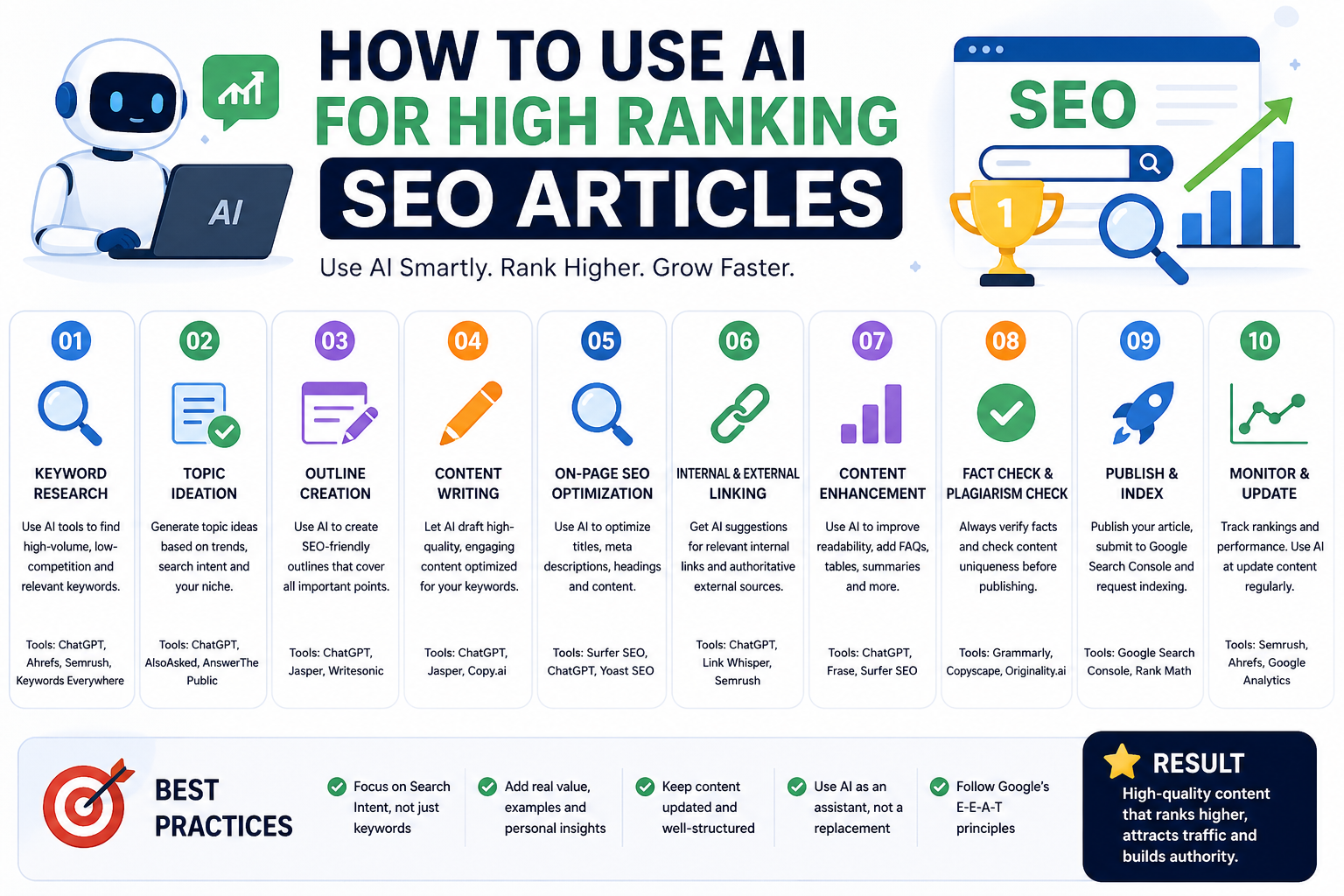
Search engines have changed. Publishing random keyword-stuffed content no longer works. Today, ranking high on search engines requires quality, relevance, user satisfaction, expertise, and strong structure. This is where Artificial Intelligence (AI) becomes powerful—not as a replacement for writers, but as a tool that helps create smarter, faster, and better SEO content.
Many people use AI the wrong way. They ask AI to write an entire article in one click, copy-paste it, publish it, and hope it ranks. Usually, it doesn’t last. Search engines reward helpful content, not lazy automation.
The smart way to use AI is as an assistant for research, outlining, optimization, idea generation, clarity improvement, and scaling quality content. In this article, you’ll learn exactly how to use AI for high-ranking SEO articles the right way.
Why AI is Powerful for SEO Content Writing
AI can help with nearly every stage of content creation:
- Keyword research support
- Search intent analysis
- Content outlines
- Title generation
- Meta descriptions
- Topic clustering
- FAQ generation
- Improving readability
- Updating old articles
- Internal linking suggestions
- Content scaling
Instead of spending 8 hours on one article, AI can reduce the process significantly while improving consistency.
But remember:
AI + Human Strategy = Rankings
AI Alone = Generic Content
Step 1: Start With Search Intent, Not Just Keywords
Many beginners focus only on keywords. But ranking happens when your article matches what users actually want.
Example keyword:
best running shoes for beginners
What does the user want?
- Product recommendations
- Comparison
- Budget options
- Comfort advice
- Buying guide
If you write only a definition of running shoes, it won’t rank.
Use AI prompts like:
- What is the search intent behind “best running shoes for beginners”?
- What sections should an article include for this keyword?
- What questions do users ask before buying running shoes?
AI helps decode user intent faster.
Step 2: Find Low Competition Keywords
You need realistic keywords, especially for new websites.
Instead of targeting:
- Best credit cards
- Weight loss
- SEO tips
Try long-tail keywords:
- Best credit cards for college students with no income
- Weight loss breakfast ideas for busy moms
- SEO tips for local bakery websites
Use AI to brainstorm long-tail keywords:
Prompt:
Give me 50 low competition long-tail keywords related to home workouts.
Then validate using SEO tools like:
- Ahrefs
- Semrush
- Ubersuggest
- Google Keyword Planner
AI gives ideas. Tools confirm difficulty.
Step 3: Build a Strong Outline Before Writing
Top-ranking articles are organized.
Use AI to create content structures based on search intent.
Prompt:
Create an SEO article outline for “How to Start a Podcast for Beginners”.
Good output may include:
- Introduction
- What equipment you need
- Choosing podcast niche
- Recording software
- Editing basics
- Publishing platforms
- Promotion tips
- Common mistakes
- FAQ
- Final thoughts
This saves time and creates logical flow.
Step 4: Generate Better Headlines
Your title affects clicks.
Even if you rank #3, a better title can beat #1 in CTR.
Use AI prompts:
- Write 20 SEO titles for keyword “healthy breakfast ideas”
- Make these titles more clickable
- Add numbers and emotional triggers
Examples:
- 15 Healthy Breakfast Ideas You Can Make in 10 Minutes
- Healthy Breakfast Ideas for Weight Loss (Easy & Fast)
- 21 Healthy Breakfast Ideas That Actually Taste Good
Step 5: Write Helpful First Drafts With AI
Now use AI to generate sections—not the whole article blindly.
Instead of:
Write full article on SEO.
Use:
Write a beginner-friendly section explaining on-page SEO in simple language with examples.
Better workflow:
- Generate section by section
- Rewrite with your tone
- Add expertise
- Add examples
- Add real experience
This creates unique and useful content.
Step 6: Add Human Experience (Very Important)
Search engines increasingly value experience and trust.
AI cannot replace real experience.
Add:
- Personal results
- Screenshots
- Case studies
- Examples
- Mistakes you made
- Tools you tested
- Before/after results
Example:
Instead of:
“Email marketing helps businesses grow.”
Write:
“We tested a 5-email welcome sequence for a fitness brand and increased repeat purchases by 18% in 30 days.”
That is stronger and more trustworthy.
Step 7: Optimize On-Page SEO With AI
AI can help optimize:
Keyword Placement
Use main keyword in:
- Title
- First 100 words
- H2 headings
- Meta description
- URL
- Naturally through content
Semantic Keywords
For “dog training tips” use related terms:
- puppy behavior
- obedience training
- leash walking
- positive reinforcement
Prompt:
Give me semantic keywords related to dog training tips.
This helps topic depth.
Step 8: Improve Readability
Most content fails because it is boring or hard to read.
Use AI to improve:
- Sentence flow
- Simplicity
- Grammar
- Short paragraphs
- Transitions
- Active voice
Prompt:
Rewrite this paragraph for better readability at 8th grade level.
Readable content improves engagement and dwell time.
Step 9: Add FAQs for Extra Rankings
FAQ sections help capture more searches.
Prompt:
Give me 15 frequently asked questions about intermittent fasting.
Example:
FAQ
Is intermittent fasting safe daily?
For many healthy adults yes, but needs personal suitability.
Can I drink coffee while fasting?
Black coffee usually yes.
How long until results show?
Often 2–4 weeks depending on goals.
FAQs can help with long-tail traffic.
Step 10: Create Strong Meta Titles & Descriptions
Meta title = clicks
Meta description = clicks support
Prompt:
Write 10 meta titles under 60 characters for keyword “budget travel tips”
Write 10 meta descriptions under 155 characters.
Example:
Meta Title: Budget Travel Tips: Save More on Every Trip
Meta Description: Discover practical budget travel tips for flights, hotels, food, and planning without sacrificing fun.
Step 11: Use AI to Update Old Content
Refreshing old posts is powerful SEO.
Use AI prompts:
- What sections are outdated in this article?
- Suggest 2026 updates for this content
- Add new FAQs
- Improve headline CTR
- Add missing subtopics competitors cover
Often easier to update than write new posts.
Step 12: Build Topic Clusters
One article is weaker than a content ecosystem.
Example main topic: SEO
Cluster articles:
- On-page SEO guide
- Technical SEO basics
- Link building for beginners
- Local SEO tips
- SEO mistakes to avoid
- SEO tools comparison
Use AI prompt:
Build a topic cluster for beginner SEO blog.
Interlink all articles.
This builds authority.
Step 13: Use AI for Internal Linking
Prompt:
Suggest internal linking opportunities between these article titles.
Internal links help:
- Crawlability
- Session time
- Authority flow
- User navigation
Step 14: Detect Content Gaps
Ask AI:
Compare these two ranking articles and tell me what topics they cover that mine misses.
This helps create more complete content.
Step 15: Scale Content Without Losing Quality
Best model:
Bad Scaling
100 AI articles in 10 days = low quality
Smart Scaling
10 excellent AI-assisted articles per month = strong growth
Quality beats volume.
Common Mistakes to Avoid
1. Publishing Raw AI Content
Usually generic, repetitive, weak.
2. Ignoring Search Intent
Wrong format = no rankings.
3. Overusing Keywords
Looks spammy.
4. No Human Editing
Misses trust and originality.
5. No Promotion
SEO content still needs backlinks and visibility.
Best AI Prompts for SEO Writers
Keyword Ideas
Give me 100 long-tail keywords about skincare for oily skin.
Outline
Create a ranking article outline for beginners learning stock investing.
Competitor Gap
What subtopics do top-ranking pages cover for this keyword?
Rewrite
Rewrite this paragraph to be clearer and more engaging.
FAQ
Give 20 real user questions about keto diet.
Human + AI Workflow Example
For keyword:
best laptops for students
AI Does:
- Keyword variations
- Outline
- Product comparison structure
- FAQs
- Meta description
Human Does:
- Test products
- Real opinions
- Performance insights
- Buying recommendations
- Trustworthy conclusions
That combination wins.
Does Google Penalize AI Content?
Google generally focuses on content quality, usefulness, and spam signals rather than whether AI assisted in writing. If AI content is low-value, copied, misleading, or mass-produced spam, it can perform poorly.
Helpful AI-assisted content can rank.
The key question is:
Did this content genuinely help the user?
Final SEO Checklist Before Publishing
- Matches search intent
- Strong headline
- Clear introduction
- Useful sections
- Easy readability
- Main keyword naturally placed
- Related keywords included
- FAQs added
- Internal links added
- Human edits completed
- Unique insights included
- Meta title + description optimized
Final Thoughts
AI is one of the best tools ever created for SEO content writing—but only when used strategically.
Do not use AI as a lazy content machine.
Use AI as:
- Research assistant
- Outline builder
- Writing helper
- Optimization tool
- Scaling partner
Then add your expertise, voice, examples, and value.
That is how you create high-ranking SEO articles in the modern era.
Short Formula to Remember
AI for speed
Human for value
SEO for visibility
Consistency for growth
Use all four together, and rankings become much more realistic.