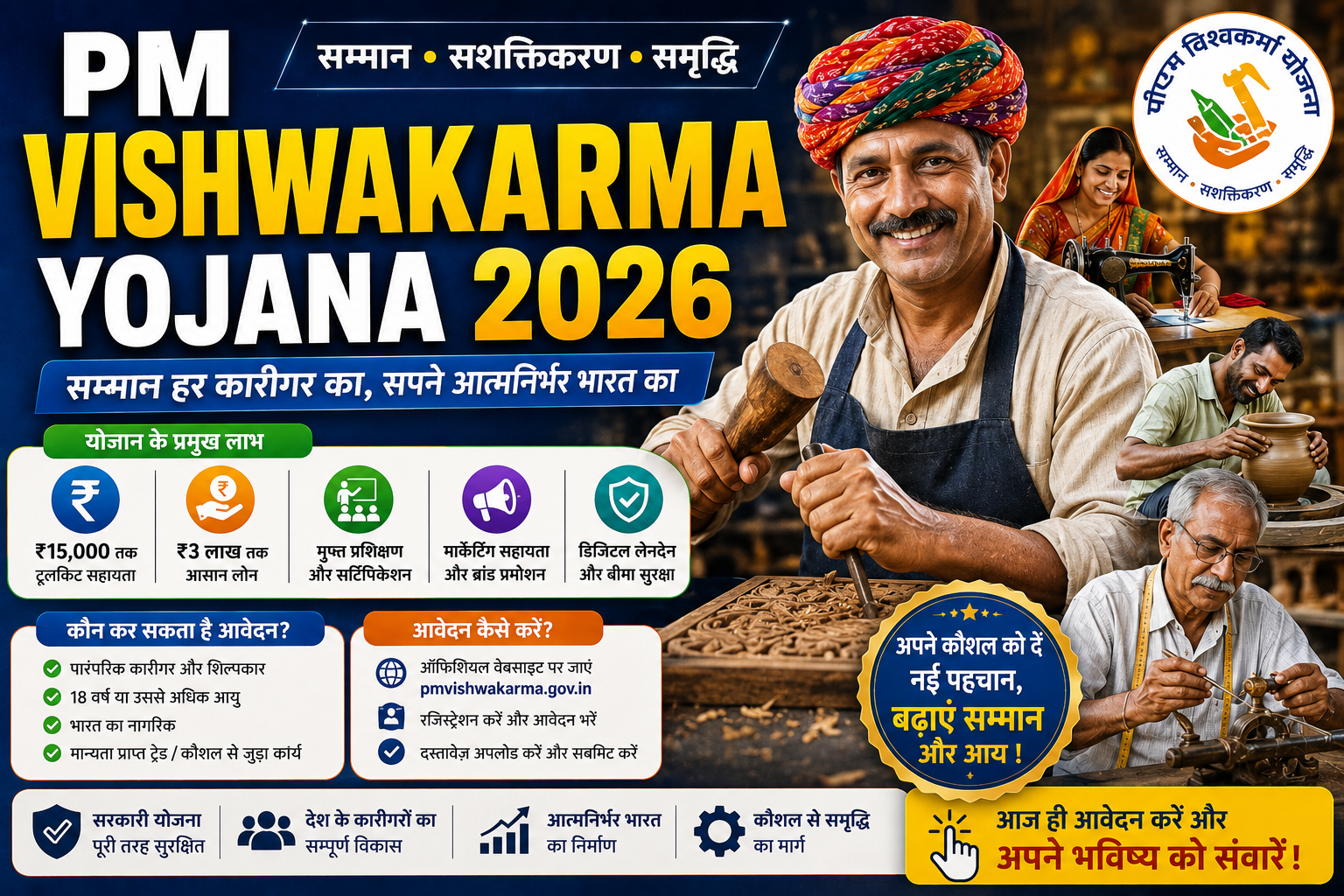
The PM Vishwakarma Yojana (launched September 2023) is still active in 2026 for traditional artisans – carpenters, blacksmiths, goldsmiths, potters, cobblers, masons, doll makers, tailors, and about 18 other trades. The online application process has matured over three years, but confusion remains. I’ll tell you exactly how to apply, what documents actually work, and what mistakes get your form rejected.PM Vishwakarma Yojana 2026
First, Check If You’re Eligible (Don’t Waste Time Applying if No)
The scheme is only for GST-registered or informal artisans who work with their hands in traditional crafts. By 2026, these are the hard eligibility rules:
- Age: 18+ years (no upper limit officially, but those above 65 rarely get loans approved)
- Family income: No formal income ceiling, but in practice, if your family pays income tax above ₹5 lakh/year, you won’t get the loan part.
- Trade: Must be one of the 18 notified trades. The full list is on the portal – common ones: carpenter (suthar), blacksmith (lohar), goldsmith (sonar), potter (kumhar), cobbler (chamar/jutawala), tailor (darzi), mason (raj mistri), basket weaver, doll/toy maker, fishing net maker, etc.
- Not eligible: Anyone who already took a government loan under Mudra, PMEGP, or similar in the last 5 years. Also, no salaried employee or registered company director.
Ground reality: The scheme targets the working poor artisan – the one sitting in a small shop or working from home. If you have a fancy workshop with AC and employees, your application will be rejected at the verification stage.
Documents You Need Before You Even Open the Portal
Keep these ready as scanned copies or clear photos (JPEG or PDF, under 1MB each):
- Aadhaar card (mobile number linked to Aadhaar is mandatory – OTP will come there)
- Voter ID or Driving License (for address proof – electricity bill also works but less preferred)
- Bank passbook front page (showing account number, IFSC, and your name exactly as on Aadhaar)
- Trade proof (this is where most fail) – Options:
- Old GST registration certificate (even if discontinued)
- Certificate from local panchayat or municipal corporation (get one from your ward member)
- Membership card from any traditional artisan cooperative
- For tailors/cobblers: a simple self-declaration on ₹10 stamp paper that you’ve been practicing the trade for at least 1 year
- Recent passport-size photo (no selfie with phone – get a proper one from a shop)
Pro tip: In 2026, the portal rejects blurry or angled photos. Use a scanner app on your phone with auto-crop.
The Actual Online Application Process (Step by Step)
Open your mobile browser (Chrome or Firefox works best – avoid UC Browser or Opera). Do not use the UMANG app for initial registration – it’s buggy. Use the official web portal.
Step 1 – Go to the right website
Type exactly: pmvishwakarma.gov.in (no “www” needed). Beware of fake sites like pmvishwakarma-scheme.com or .org – they are scams asking for money.
Step 2 – Click “Apply Online” (yellow button on top right)
It will take you to a registration page. Click “New Registration”.
Step 3 – Enter your mobile number and Aadhaar
OTP will be sent to your Aadhaar-linked mobile. Enter the OTP. If you don’t receive it within 30 seconds, check if your mobile is actually linked to Aadhaar. This is the #1 reason applications fail – people use a different number.
Step 4 – Fill the 5-page form
The form has sections:
- Personal details (name, father’s name, DOB – match exactly with Aadhaar)
- Address (village/town, district, state, pincode)
- Trade details (select your trade from dropdown – don’t write it manually)
- Bank account (verify using the “Fetch Bank Details” button – if it says “account not found”, your bank might not be linked to Aadhaar. Fix that first.)
- Previous loan declaration (just tick “No” unless you’ve taken any govt scheme loan)
Step 5 – Upload documents
The portal will ask for each document in a specific field. Don’t upload PAN card where they ask for Aadhaar. Keep file names simple like aadhaar.jpg – no spaces or special characters.
Step 6 – Self-certification
Tick all the declaration boxes. One important box: “I have not taken any loan above ₹50,000 from any bank in the last 12 months” – if you have, your application will be flagged. Be honest.
Step 7 – Submit and download acknowledgement
After final submit, you’ll get an application number (format: PMVK/2026/XXXXX). Screenshot it immediately. You will not receive an SMS for at least 2-3 days. If you lose that number, you cannot track your application.
What Happens After You Apply (The 2026 Reality)
- Within 7 days: A local official (usually from the Industries Department or Block Development Office) will visit your workshop/home for verification. They will take photos of you with your tools/products. This is mandatory. If you’re not there after 2 attempts, application rejected.
- Within 15 days: You’ll get an SMS saying “Verification Complete” or “Additional Documents Needed”. If the latter, log back in and upload whatever they ask – usually a clearer photo of your trade proof.
- Within 30-45 days: You’ll receive a Provisional Certificate online. Download it. This certificate allows you to:
- Get a ₹10,000 loan at 0% interest (yes, zero percent – but it’s only ₹10k, for tool purchase)
- Enroll in free 5-day skill training (worth ₹500 stipend per day)
- After that, you can apply for Tranche 2 loan of ₹2 lakh at 5% interest (effective rate after subsidy)
Important: The “free money” rumors are false. You don’t get cash credited to your account. You get a loan. The subsidy is on the interest. The skill training stipend is real – ₹500 per day for 5 days, credited to your bank after training completion.
Common Mistakes That Get Your Application Rejected (2026 Data)
I’ve seen rejection rates as high as 40% in some districts. Avoid these:
- Mismatched name between Aadhaar and bank account – Even a spelling difference (“Mohd” vs “Mohammad”) causes rejection. Get your bank account name updated first.
- Trade not in the list – Some people think “electrician” or “plumber” is included. It’s not. That’s under PMKVY, not PM Vishwakarma.
- Uploading PDF of Aadhaar – The portal accepts only JPEG/PNG for identity proof. PDF for bank passbook is fine, but for Aadhaar they want image.
- Applying twice – Once you submit, do NOT apply again even if you don’t hear back. The system sees duplicate Aadhaar and auto-rejects both.
- Mobile number not linked to Aadhaar – This is the #1 reason. Go to any CSC center and get your mobile updated in Aadhaar. Takes 2 days. Then apply.
Offline Alternative (When Online Fails)
In 2026, many rural artisans still don’t have smartphones or reliable internet. Go to your nearest Common Service Centre (CSC) – the village-level digital center. They will fill the form for you for a fee of ₹50-100 (official rate). Don’t pay more. They’ll also upload documents and give you a printout of the acknowledgement. This is actually smoother than doing it yourself if you’re not tech-savvy.
Scams to Watch Out For
No government official will ever call you and ask for money to “fast-track” your application. The entire process is free. If someone calls saying “pay ₹500 for verification”, hang up. The real verification person will come to your home without demanding any fee.
Also, ignore WhatsApp forwards claiming “PM Vishwakarma Yojana 2026 – get ₹5 lakh directly in account”. That’s fake. The maximum loan under the full scheme after 3 years of good repayment is ₹3 lakh (Tranche 3). Not ₹5 lakh.
Final Word – Should You Apply in 2026?
If you are a genuine artisan working with your hands, earning less than ₹15,000-20,000 per month, and need a small loan for better tools or a workspace upgrade – yes, apply. The 0% interest on first ₹10,000 is genuinely good. The skill training stipend (₹2,500 total) is free money. Even if you don’t take the loan, the recognition certificate helps you get better rates at local banks for future needs.
But if you’re looking for a quick cash handout or you’re not actually practicing any traditional craft – skip it. The ground verification in 2026 is strict. They will ask you to demonstrate your skill. Fake applicants are being blacklisted for 3 years from all government schemes.
Bottom line: The application process is straightforward but unforgiving. Follow each step exactly as above. Don’t rush. Double-check every document. And remember – patience is the real requirement. From application to actually getting the loan in your account, expect 3-4 months. That’s the reality of Indian bureaucracy. Still, for those who genuinely need it, it’s worth the wait.
Most vendors will ask you to pay the full amount (say ₹90,000 for 3kW) and promise to “adjust” the subsidy later. Don’t agree. You only pay the subsidy-deducted price (approx ₹50,000-60,000). The remaining ₹30,000-40,000 subsidy is credited by the government directly to your bank account after net meter installation. If you pay full, the vendor may delay or never refund you. Get this in writing.
2. If verification doesn’t happen within 15 days, visit the DISCOM office yourself
The online portal will just show “pending”. Don’t wait for months. Go to your electricity distribution company (DISCOM) office with your application printout. Ask for the Solar Cell department. In 2026, most DISCOMs have a dedicated desk. Politely but firmly request field verification. Works 80% of the time.
3. Don’t install if your roof has any shade – even from a water tank
This kills the scheme for many. Solar panels need direct sunlight from 9 AM to 3 PM. A single shadow from a neighbor’s building, a large tree, or even a 5-foot water tank can drop generation by 40-50%. Before applying, do this: Stand on your roof at 10 AM, 12 PM, and 2 PM. Check if any shadow covers more than 20% of the proposed panel area. If yes – do not install. You’ll never break even.
4. Monthly fixed charges still apply even if your bill is zero
This is the “hidden cost”. After solar, your consumption bill becomes zero, but DISCOM will still charge you ₹100-400 per month as fixed charges (meter rent, service charges). In some states like Uttar Pradesh and Bihar, it’s ₹300+. Factor this into your savings calculation. If your original bill was ₹600, you’ll still pay ₹300 fixed – so actual saving is only ₹300/month. Payback period doubles.
5. Loan EMIs can cancel out your savings – calculate carefully
The optional SBI/NHB loan at 6.5% sounds good, but for a 3kW system costing ₹60,000 (after subsidy), a 5-year EMI is about ₹1,200/month. If your monthly electricity bill was ₹1,500, you save only ₹300/month for 5 years. After 5 years, EMI ends, then real saving starts. So don’t expect instant “muft bijli”. Be patient.
PM Vishwakarma Yojana – Ground Truths for 2026
1. The first loan is only ₹10,000 at 0% – but that’s genuine free money
Yes, zero interest. But many expect ₹2 lakh directly. No. First, you get tool loan of ₹10,000 (repayable in 6 months, no interest). Only after repaying that and completing 5-day skill training, you become eligible for Tranche 2 loan of ₹2 lakh at 5% effective rate. So timeline: 3-4 months for first loan, then 6 months repayment, then apply for bigger loan – total 1 year minimum.
2. The skill training stipend (₹500/day) is real but attendance is strict
You get ₹2,500 for 5 days of training. But in 2026, biometric attendance is mandatory – morning and evening. Missing even half a day cuts your stipend proportionally. Also, the training content is basic (safety, digital payments, design basics). Don’t expect advanced skill upgrade. The real value is the stipend and the certificate, not the training itself.
3. The physical verification officer WILL ask to see your work
No joke. They come to your home/workshop and ask you to demonstrate your craft. For a carpenter: show your tools, a half-finished product, wood shavings. For a tailor: show your sewing machine, some stitched clothes. Fake applicants get caught here. In 2026, many districts also take a short video of you working. If you can’t prove you actually practice the trade, application rejected immediately.
4. You cannot apply if you already have a Mudra loan or PMEGP loan
The system checks your PAN and Aadhaar against government loan databases. If you took any loan under Mudra, PMEGP, or Stand-Up India in the last 5 years, your application is auto-rejected. There is no way around it. Don’t waste time applying.
5. The loan is not cash in hand – it’s directly paid to the equipment supplier
Many expect ₹2 lakh to land in their bank account. No. The bank pays the vendor (tool supplier, raw material supplier) directly. You just get the goods. For example, if you want a new sewing machine, you choose a shop, the bank pays that shop, and you collect the machine. This prevents misuse but also means you cannot use the money for rent or other expenses.
6. CSC centers charge ₹100-150 – that’s fine, but more than that is cheating
Official fee for CSC to file your application is ₹50 + GST. But most village CSCs charge ₹100-150 for “typing charges”. That’s acceptable if they also scan and upload documents. But if anyone asks for ₹500 or more, walk away. Also, never pay anyone who promises “guaranteed approval” or “fast tracking”. The process takes 45-60 days for everyone.
7. Renewal of certificate every 3 years is mandatory
Your PM Vishwakarma certificate (which you get after first loan) is valid for 3 years. After that, you must apply for renewal online – simply update your address, trade status, and loan repayment history. If you don’t renew, you cannot apply for the next tranche loan. Set a reminder.
General Important Tips for Both Schemes (2026)
Always take a printout of your application acknowledgement
Do not rely on SMS. The government portal sometimes has glitches. That printed acknowledgement with application number is your only proof. Keep it in a file.
Use only your Aadhaar-linked mobile number
This is non-negotiable. Both schemes send OTPs and status updates to that number. If your mobile is not linked to Aadhaar, visit any CSC or bank to update it. Takes 2 days. Without this, your application will never proceed.
Never pay anyone for “verification” or “approval”
Verification officers are government employees. They never ask for money. If someone in uniform asks for ₹200 for “tea and travel”, report them immediately on the scheme’s helpline number. Both schemes have strict anti-corruption measures in 2026.
The helpline numbers actually work now – use them
- PM Surya Ghar: 1800-11-4423 (toll-free, 9 AM to 6 PM)
- PM Vishwakarma: 1800-267-6888
They will give you a complaint ticket number if your application is stuck. Use it.
If online is not working, go to your local Jan Seva Kendra or CSC
Don’t struggle with a slow phone. Pay ₹100-150 and get it done offline through a Common Service Centre. They have experience and know the common errors. Many village artisans prefer this route in 2026.
Be patient – India’s government schemes run on “sarkari time”
Approvals take 30-90 days. Loans take another 30 days. Don’t panic if you don’t hear back in 2 weeks. The system is slow, but it works. Follow up every 15 days politely. Yelling at officials won’t help – a calm written application to the District Magistrate does wonders.
That’s the real stuff, brother. No sugarcoating. If you have a specific question about your situation (your roof type, your trade, your state, your income level), tell me – I’ll give you personalized advice. Otherwise, follow these points step by step, and you’ll save yourself months of frustration.
qdomfieeoljmfhwqqfudlhgtrpiuzt