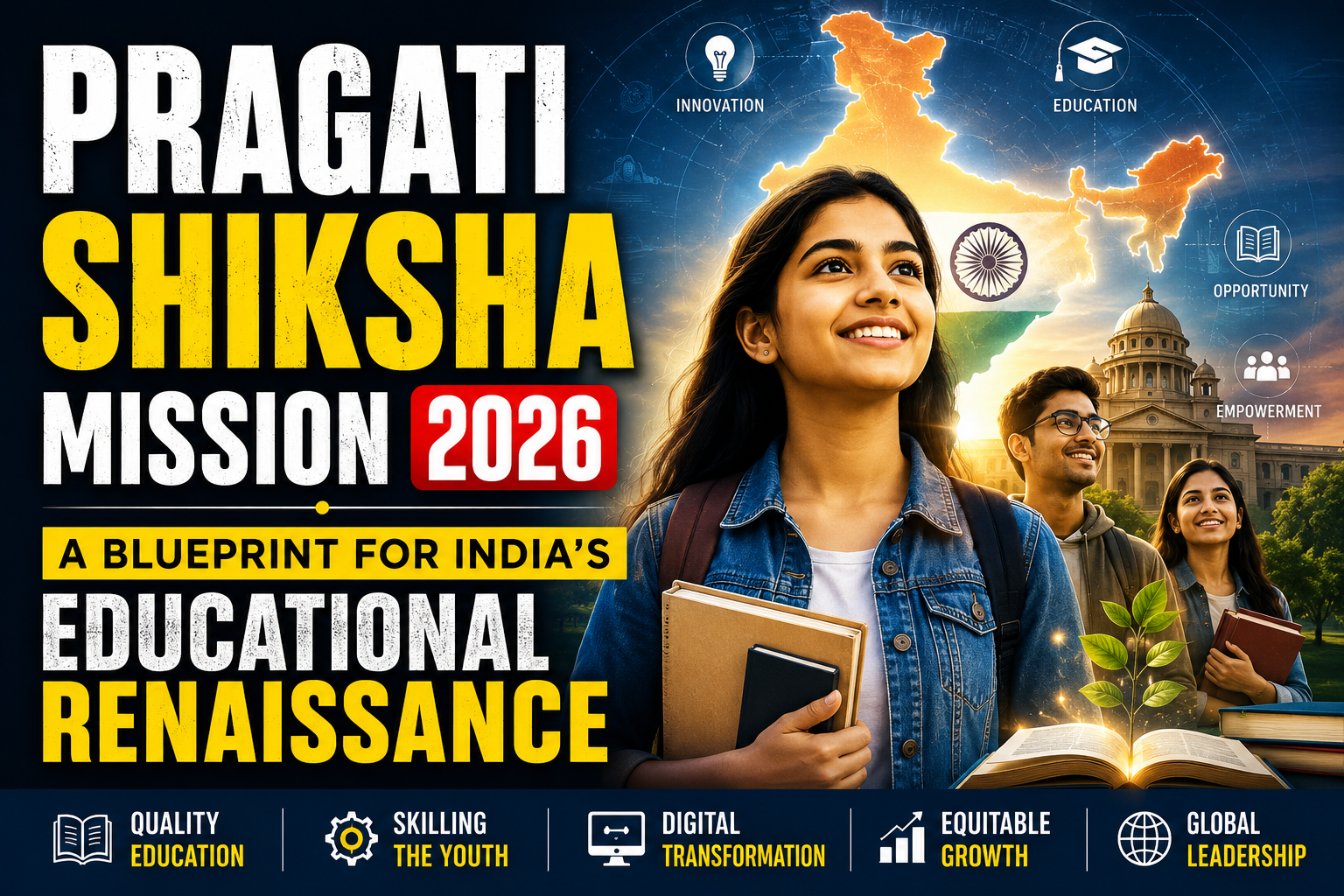
India stands at a pivotal moment in its history. As the nation aspires to become a global leader, its most crucial asset is not its natural resources or industrial output, but its human capital. The future of the world’s largest democracy hinges on the strength, creativity, and knowledge of its youth. It is in this context that the “Pragati Shiksha Mission 2026” emerges not just as a government policy, but as a transformative vision for the future of the nation. The word “Pragati” translates to progress, and this mission is designed to be the engine that drives India forward through a renaissance in its educational system. It is a recognition that the traditional, rote-based, examination-centric model of education has long outlived its utility and that a new, dynamic, and holistic approach is urgently needed.Pragati Shiksha Mission 2026
The mission, therefore, represents a paradigm shift. It is an ambitious attempt to overhaul the very fabric of how India learns, teaches, and evaluates. Launched with the goal of achieving significant, measurable improvements by the year 2026, it seeks to address the systemic issues that have plagued the Indian education system for decades: inequality of access, outdated curricula, a focus on memorization over understanding, and a severe disconnect between academic learning and employable skills. The timeline of 2026 is not arbitrary; it is a self-imposed deadline that creates a sense of urgency and accountability, forcing stakeholders to move beyond deliberation and into decisive action.
This article delves deep into the various facets of the Pragati Shiksha Mission 2026. It explores its genesis, its core philosophies, its major initiatives, and the profound challenges it must overcome to succeed. We will analyze its potential to democratize education, re-skill the workforce, foster innovation, and ultimately, build a more equitable and prosperous India. The success of this mission is not merely a governmental responsibility; it is a collective undertaking that requires the participation of educators, parents, communities, and students themselves. It is a call to action for every Indian who believes in the power of education to change lives and build a better future.
The Genesis of a New Vision
The Pragati Shiksha Mission 2026 was born out of a series of harsh realities. For decades, India’s educational institutions have produced millions of graduates, yet a staggering number remain unemployable due to a lack of practical skills. The World Bank and various other international bodies have consistently highlighted the “skills gap” in India, where the curriculum does not align with the needs of a rapidly evolving global economy. This disconnect has led to a paradox: while India has a surplus of young people, industries are struggling to find talent with the right competencies.
Furthermore, the quality of education has historically been tied to one’s socioeconomic status. The privileged few in elite private institutions have had access to world-class resources, while the vast majority of students in government schools have grappled with inadequate infrastructure, poorly trained teachers, and a lack of basic learning materials. This deep-seated inequality has perpetuated a cycle of poverty and limited social mobility. The COVID-19 pandemic brutally exposed these fault lines. As schools shut down, the digital divide became a chasm, and millions of students, particularly in rural areas, were left without access to education.
The 2020 National Education Policy (NEP) was a watershed moment, laying the conceptual groundwork for many of the reforms now being implemented under the Pragati Shiksha Mission. The NEP called for a move away from rote learning and towards a more holistic, multidisciplinary, and experiential education system. It emphasized the importance of early childhood care, foundational literacy and numeracy, and critical thinking. The Pragati Shiksha Mission 2026 can be seen as the NEP’s execution arm, translating its ambitious vision into a time-bound, actionable roadmap.
The mission was also a response to the demands of the 21st-century workplace. The Fourth Industrial Revolution, characterized by automation, artificial intelligence, and digital technologies, is reshaping the nature of work. Jobs that exist today may be obsolete tomorrow, and new roles that we cannot even imagine are being created. The Pragati Shiksha Mission, therefore, prioritizes not just teaching specific skills, but fostering adaptability, resilience, and a lifelong love for learning. It is designed to equip students to navigate an unpredictable future with confidence and competence.
The Five Pillars of Transformation
To achieve its ambitious goals, the Pragati Shiksha Mission 2026 rests on five core pillars. Each pillar addresses a critical aspect of the educational ecosystem and is interconnected with the others.
1. Digital Literacy and Infrastructure (The Technological Leap)
Perhaps the most visible aspect of the mission is its aggressive push for digitalization. The government recognizes that technology is not merely a tool for teaching but a fundamental catalyst for democratizing education. The mission aims to provide universal access to digital infrastructure, including high-speed internet and smart devices, to every school and classroom. This is being facilitated through initiatives like the expansion of the BharatNet project to connect all villages and the provision of affordable tablets and laptops to students.
However, digital literacy extends beyond access. The mission places a strong emphasis on training teachers and students to effectively use digital tools. It promotes the development of high-quality, multilingual digital content, making learning resources available in all major Indian languages. Platforms like DIKSHA (Digital Infrastructure for Knowledge Sharing) are being revitalized to offer a vast repository of interactive lessons, videos, and assessments. The goal is to create a blended learning model where technology enhances traditional classroom instruction, making learning more engaging, personalized, and accessible. For the first time, a student in a remote village can have access to the same quality of resources as a student in a metropolitan city, bridging the educational divide.
2. Teacher Empowerment and Training (The Guardian of Knowledge)
The success of any educational reform is inextricably linked to the quality of its teachers. The Pragati Shiksha Mission 2026 acknowledges that teachers are the nation-builders and invests heavily in their professional development. The mission has established robust training programs to equip teachers with modern pedagogical methods. This includes training in using digital tools, designing activity-based learning experiences, and implementing competency-based assessments.
Furthermore, the mission focuses on improving the status and morale of teachers. Efforts are being made to streamline the recruitment process, provide better compensation, and create clear career progression paths. The “Teacher as a Mentor” concept is being promoted, moving away from the traditional “sage on the stage” model to a more collaborative and facilitative role. Teacher training is no longer a one-time event but a continuous process of professional development, with programs designed to help teachers adapt to the changing needs of students and the curriculum. Special emphasis is placed on training teachers in foundational literacy and numeracy, ensuring that students build a strong base from the very beginning of their academic journey.
3. Experiential and Competency-Based Learning (Beyond the Textbook)
The most significant pedagogical shift under the mission is the move from rote memorization to experiential and competency-based learning. The curriculum is being redesigned to be more application-oriented, focusing on developing skills like problem-solving, critical thinking, communication, and collaboration. The traditional 10+2 structure is being replaced with a more flexible 5+3+3+4 model that aligns with the cognitive development stages of children.
This new approach emphasizes “learning by doing.” Students are encouraged to engage in hands-on activities, experiments, project work, and real-world problem-solving. Internships, vocational training, and apprenticeships are being integrated into the curriculum to provide students with practical experience and exposure to various career paths. Assessment methods are also being reformed. Instead of relying solely on high-stakes, one-time examinations, the focus is shifting towards continuous and comprehensive evaluation that measures a student’s understanding, skills, and application of knowledge. This competency-based approach ensures that learning is genuine and durable, preparing students for higher education and the workforce.
4. Inclusivity and Universal Access (Leaving No One Behind)
For education to be a true engine of social change, it must be accessible to all. The Pragati Shiksha Mission 2026 is deeply committed to ensuring inclusivity and universal access. Special initiatives have been launched to bring out-of-school children back into the education system, with a particular focus on girls, students from Scheduled Castes and Tribes, and children with disabilities.
The mission promotes the development of accessible learning materials, including audio, video, and braille formats. Schools are being equipped with infrastructure to accommodate children with physical disabilities. Furthermore, the mission recognizes the importance of addressing socio-economic barriers to education. The provision of mid-day meals, scholarships, and free uniforms has been strengthened to reduce the burden on economically disadvantaged families. The use of technology is also leveraged to provide education in mother tongues, making learning more relatable and effective for students from diverse linguistic backgrounds. The goal is to create a truly democratic education system where every child, regardless of their background, has the opportunity to reach their full potential.
5. Governance and Accountability (Streamlining the System)
The fifth pillar focuses on strengthening the administrative and governance framework of the educational system. The mission aims to create a more transparent, responsive, and efficient system of education management. This involves streamlining regulations, reducing bureaucratic hurdles, and promoting autonomy for schools and institutions.
A key component is the establishment of a robust data management system to track student enrollment, learning outcomes, and teacher performance. This data-driven approach enables evidence-based policymaking and allows for the identification of areas that need improvement. The mission also promotes a culture of accountability, with regular audits and public disclosure of performance indicators. Parents and communities are being empowered to participate in school governance through School Management Committees (SMCs), fostering a sense of shared responsibility. This decentralized approach ensures that schools are more responsive to the needs of their local communities.
Implementation: The Roadmap to 2026
The journey from policy to practice is often fraught with challenges. The Pragati Shiksha Mission 2026 has a structured, multi-phased implementation strategy.
Phase 1 (Foundation – 2024): This initial phase focused on laying the groundwork. It involved setting up the necessary administrative structures, creating detailed action plans, conducting baseline surveys to assess the current state of education, and launching large-scale awareness campaigns. The development of new curricula and textbooks was initiated. Teacher training modules were finalized, and the procurement of digital infrastructure began. This phase was about creating the infrastructure and resources needed for the subsequent, more intensive phases of the mission.
Phase 2 (Execution – 2025): This is the core implementation phase where the “rubber meets the road.” The new curriculum and pedagogical approaches were rolled out in schools across the country. Teacher training programs were conducted en masse, both online and in-person. The distribution of digital devices, connectivity, and learning materials was accelerated. Pilot projects in various states were scaled up. This phase is characterized by intensive, large-scale action to ensure that the foundational changes are taking root in the classroom. It is a period of active learning, where feedback from the field is being used to refine the approach.
Phase 3 (Evaluation and Consolidation – 2026): The final phase before the target year is dedicated to assessment and improvement. A comprehensive nationwide evaluation will be conducted to measure the impact of the mission’s initiatives. Based on the data gathered, strategies will be refined, and best practices will be identified and scaled. This is not an end but a beginning. The insights gained will inform the long-term trajectory of educational reform in India. The goal is to establish a self-sustaining system of continuous improvement that will continue to evolve long after 2026.
The Challenges on the Horizon
While the vision of the Pragati Shiksha Mission is inspiring, its path is fraught with significant obstacles. Acknowledging these challenges is not an act of pessimism but a necessary step for building resilience and ensuring success.
The Deepening Digital Divide: While the mission aims to bridge this gap, the reality is that disparities in access to electricity, internet connectivity, and affordable devices remain stark, particularly in rural and remote areas. The ambition of universal digital access must contend with the practicalities of India’s vast and diverse geography.
The Quality of Teacher Training: Training millions of teachers in a short period is a logistical and pedagogical nightmare. The success of teacher training depends not just on the content delivered, but on the ability of teachers to change their mindset and adopt new teaching styles. Ensuring that these programs are effective and lead to tangible changes in the classroom is a monumental challenge.
Infrastructural Bottlenecks: The mission’s success depends on a massive upgrade of school infrastructure. Many government schools lack basic amenities like adequate classrooms, libraries, and laboratories. Building new schools and upgrading existing ones requires enormous investment and efficient project management. The speed of execution must keep pace with the ambition of the mission.
Socio-Economic Barriers: Education cannot be viewed in a vacuum. For many children, especially in rural India, education competes with the need to contribute to the family income. Malnutrition, lack of hygiene, and societal pressures, particularly on girls, are powerful deterrents to school attendance and engagement. The mission’s success depends on its ability to address these deep-rooted socio-economic issues in partnership with other government departments.
The Bureaucratic Hurdle: The Indian administrative system is often characterized by rigid hierarchies and slow decision-making. Transforming the education system requires agility and flexibility, which are often at odds with established bureaucratic processes. Overcoming this inertia and creating a responsive and empowered administrative culture is crucial.
The Promising Horizon: A Vision for 2026 and Beyond
Despite the challenges, the Pragati Shiksha Mission 2026 holds immense promise. If implemented effectively, its impact will be felt for generations.
By 2026, we can expect to see an education system that is far more inclusive, engaging, and relevant. Students will not just be passive recipients of information but active participants in their own learning journey. The development of foundational skills in literacy and numeracy will be prioritized, ensuring that all children have a strong base for future learning. The new curriculum will foster critical thinking, creativity, and innovation, producing young minds ready to solve complex problems and contribute to India’s economic growth.
The mission has the potential to transform India into a global hub for talent. By bridging the skills gap, India can harness its demographic dividend to become a major supplier of skilled manpower to the world. This will not only drive economic prosperity but also enhance India’s geopolitical standing. The empowerment of teachers and the democratization of educational resources will elevate the standard of education across the nation, narrowing the gap between urban and rural institutions.
Furthermore, the focus on inclusivity has the potential to create a more just and equitable society. By empowering marginalized communities through education, the mission can contribute to breaking the cycle of poverty and discrimination. An educated population is a more aware, engaged, and responsible citizenry, which is the cornerstone of a vibrant democracy.
A Collective National Effort
The Pragati Shiksha Mission 2026 is more than a government program; it is a call for a national movement. Its success requires the active participation of every stakeholder. The government must continue to provide the necessary policy support and financial resources. The private sector must partner with the government to provide technology, expertise, and vocational training opportunities. Educational institutions must embrace the spirit of reform and implement the new curricula and pedagogical approaches with dedication.
Parents must be active partners in their children’s education, providing support and encouragement at home. Communities must create an environment that values and promotes education. And finally, students themselves must embrace the opportunity, cultivating a love for learning and taking ownership of their own development.
The journey of 3,000 words has only scratched the surface of this complex and ambitious mission. The Pragati Shiksha Mission 2026 is a testament to India’s determination to build a future on the bedrock of knowledge and skill. The year 2026 is not a finish line but a milestone in a continuous journey of progress. It marks a commitment to a process of perpetual evolution, adaptation, and improvement. As India strides toward this milestone, the focus must remain on the ultimate goal: to empower every child with the knowledge, skills, and values they need to build a better life for themselves and a brighter future for the nation. The eyes of the world are on India. The success of this mission will not only define the nation’s trajectory but will also serve as a model for other developing nations seeking to harness the transformative power of education. The challenge is immense, but the opportunity is boundless. The time to act is now.