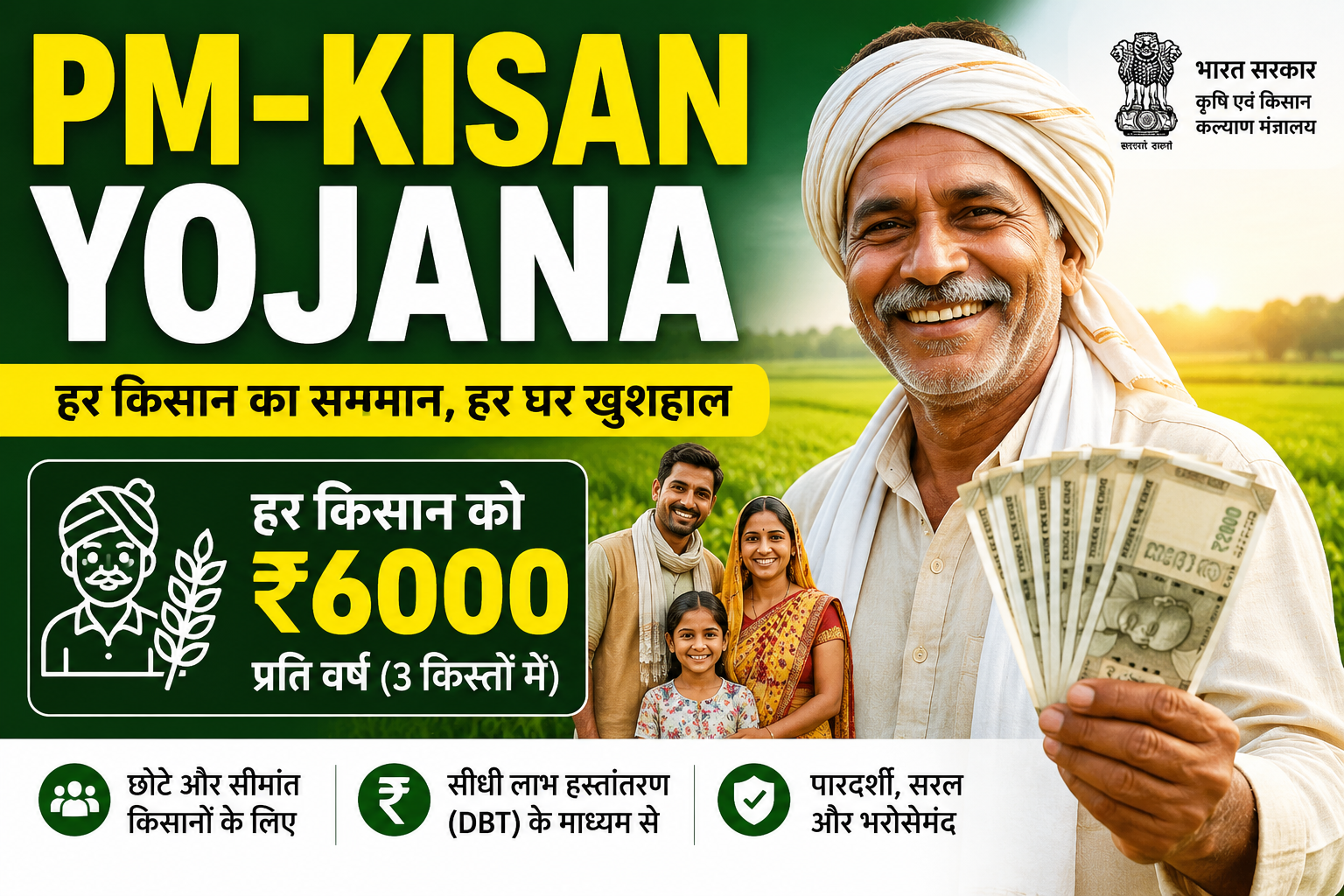
Agriculture has always been the backbone of the Indian economy. Even today, a significant percentage of India’s population depends on farming for their livelihood. However, Indian farmers often face numerous challenges, including unpredictable weather conditions, fluctuating market prices, rising cultivation costs, limited access to credit, and natural disasters. To provide financial assistance and improve the economic condition of farmers, the Government of India launched the Pradhan Mantri Kisan Samman Nidhi (PM-KISAN) scheme.Prime Minister Kisan Samman Nidhi (PM-KISAN)
PM-KISAN is one of India’s largest Direct Benefit Transfer (DBT) programs, designed to provide financial support directly to eligible farming families. The scheme helps farmers meet agricultural expenses, purchase quality seeds and fertilizers, invest in modern farming techniques, and improve their overall standard of living.
Since its launch in 2019, PM-KISAN has benefited millions of farmers across India by transferring financial assistance directly into their bank accounts. The transparent digital payment system minimizes corruption, reduces delays, and ensures that the benefits reach the intended beneficiaries.
This article provides a comprehensive overview of PM-KISAN, including its objectives, eligibility, benefits, registration process, payment system, e-KYC, beneficiary status checking, impact on agriculture, challenges, and frequently asked questions.
What is PM-KISAN?
The Pradhan Mantri Kisan Samman Nidhi (PM-KISAN) is a Central Sector Scheme introduced by the Government of India to provide financial assistance to eligible farmer families. The scheme was officially launched on 24 February 2019 by the Hon’ble Prime Minister of India.
Under this scheme, eligible farmers receive ₹6,000 annually, which is transferred directly into their bank accounts in three equal installments of ₹2,000 each.
Unlike loan-based assistance programs, PM-KISAN provides direct income support that farmers can use according to their needs. This flexibility allows them to purchase farming inputs, pay labor charges, manage household expenses, or invest in agricultural improvements.
The scheme is entirely funded by the Central Government, ensuring nationwide implementation with uniform eligibility criteria.
Background of PM-KISAN
Before PM-KISAN was introduced, several state governments had launched income support schemes for farmers. However, there was no nationwide financial assistance program that covered farmers across all states and union territories.
Recognizing the need for a national income support mechanism, the Government of India introduced PM-KISAN during the Interim Budget 2019.
Initially, the scheme covered only small and marginal farmers owning up to two hectares of cultivable land. Later, the eligibility criteria were expanded to include all landholding farmer families, subject to certain exclusion criteria.
This expansion significantly increased the number of beneficiaries and made PM-KISAN one of the world’s largest farmer welfare programs.
Objectives of PM-KISAN
The primary objective of PM-KISAN is to improve the financial stability of farmers by providing direct income support.
The key objectives include:
- Providing assured financial assistance to farmers.
- Helping farmers purchase quality seeds and fertilizers.
- Reducing dependence on informal money lenders.
- Encouraging investment in agriculture.
- Supporting sustainable farming practices.
- Increasing agricultural productivity.
- Improving rural livelihoods.
- Enhancing farmers’ income.
- Promoting financial inclusion.
- Strengthening India’s agricultural sector.
The scheme also complements several other government initiatives aimed at doubling farmers’ income and improving rural development.
Key Features of PM-KISAN
PM-KISAN offers several features that make it unique among government welfare schemes.
1. Direct Benefit Transfer (DBT)
Funds are transferred directly into the beneficiary’s bank account without involving intermediaries.
2. Central Government Funding
The scheme is fully funded by the Government of India.
3. Annual Financial Assistance
Each eligible farmer family receives ₹6,000 every year.
4. Three Installments
The annual assistance is divided into three installments of ₹2,000 each.
5. Nationwide Coverage
The scheme is implemented in all states and union territories.
6. Digital Verification
Beneficiary details are digitally verified to reduce fraud and duplication.
7. Aadhaar Integration
Aadhaar authentication helps ensure transparency and accurate beneficiary identification.
8. Online Registration
Farmers can register through online portals and Common Service Centres (CSCs).
9. Mobile Application
The PM-KISAN mobile app allows beneficiaries to check payment status, registration details, and updates.
10. Transparent System
The use of technology makes the scheme efficient, transparent, and accountable.
Financial Assistance under PM-KISAN
Every eligible farmer family receives ₹6,000 annually.
The payment schedule generally follows this pattern:
| Installment | Amount |
|---|---|
| First Installment | ₹2,000 |
| Second Installment | ₹2,000 |
| Third Installment | ₹2,000 |
The amount is directly credited to the beneficiary’s registered bank account through the Direct Benefit Transfer system.
This financial assistance can be used for:
- Buying seeds
- Purchasing fertilizers
- Buying pesticides
- Irrigation expenses
- Farm equipment
- Labor wages
- Household expenses
- Crop protection
- Small agricultural investments
Eligibility Criteria
To receive benefits under PM-KISAN, applicants must satisfy the eligibility conditions prescribed by the Government of India.
Eligible Beneficiaries
The following categories are generally eligible:
- Landholding farmer families.
- Farmers owning cultivable land.
- Small farmers.
- Marginal farmers.
- Medium farmers.
- Large farmers (subject to exclusion criteria).
- Farmers registered in state land records.
- Farmer families consisting of husband, wife, and minor children.
Ownership of cultivable land is the primary requirement.
Who is Considered a Farmer Family?
Under PM-KISAN, a farmer family consists of:
- Husband
- Wife
- Minor children
The family is treated as one unit for receiving financial assistance.
Who is NOT Eligible?
Certain categories of individuals are excluded from receiving benefits under PM-KISAN, even if they own agricultural land.
These generally include:
- Institutional landholders.
- Serving or retired constitutional post holders.
- Serving or retired government employees (subject to prescribed exceptions).
- Income tax payers in the relevant assessment period.
- Professionals such as doctors, engineers, lawyers, chartered accountants, and architects who are registered with professional bodies and actively practicing.
- Members of Parliament (MPs), Members of Legislative Assemblies (MLAs), and Members of Legislative Councils (MLCs).
- Mayors of Municipal Corporations.
- Chairpersons of District Panchayats.
- Individuals receiving higher government pensions above the prescribed limit (except eligible lower-level employees as notified).
These exclusions ensure that the financial assistance reaches economically deserving farming families.
Registration through Common Service Centres (CSCs)
Farmers who are unable to register online can visit their nearest Common Service Centre (CSC). A CSC operator assists in completing the registration process.
Services offered at CSCs include:
- New registration
- Aadhaar verification
- e-KYC assistance
- Correction of beneficiary details
- Bank account updates
- Land record verification
- Status checking
- Printing acknowledgment receipts
This option is especially useful for farmers in rural areas with limited internet access.
Documents Required for PM-KISAN Registration
Applicants should keep the following documents ready before applying:
- Aadhaar Card
- Proof of land ownership
- Bank account passbook
- IFSC Code
- Mobile number linked with Aadhaar
- Passport-size photograph (if required by the state)
- Address proof (where applicable)
The accuracy of these documents is crucial for successful verification.
Importance of Aadhaar Linking
Aadhaar serves as the primary identity document under PM-KISAN. Linking Aadhaar with the beneficiary’s bank account helps prevent duplication and ensures that the financial assistance reaches the correct individual.
Benefits of Aadhaar linking include:
- Accurate beneficiary identification
- Prevention of fraudulent claims
- Faster verification
- Direct Benefit Transfer (DBT)
- Improved transparency
- Reduced payment failures
Farmers should ensure that their Aadhaar details match their bank records to avoid delays.
PM-KISAN e-KYC
Electronic Know Your Customer (e-KYC) is mandatory for PM-KISAN beneficiaries. It confirms the identity of the farmer and ensures continued eligibility for receiving benefits.
Why e-KYC is Important
e-KYC helps:
- Verify beneficiary identity
- Eliminate fake registrations
- Improve payment accuracy
- Maintain updated records
- Ensure compliance with government guidelines
Without completing e-KYC, beneficiaries may face delays or suspension of installment payments.
Methods to Complete e-KYC
Farmers can complete e-KYC through:
- OTP-based Aadhaar authentication (online)
- Biometric authentication at CSCs
- Face authentication through the PM-KISAN mobile application (where available)
It is advisable to complete e-KYC as soon as notified to avoid interruptions in payments.
How to Check PM-KISAN Beneficiary Status
Farmers can check whether they are registered as beneficiaries through the official PM-KISAN portal.
Steps to Check Beneficiary Status
- Open the PM-KISAN website.
- Navigate to the “Know Your Status” section.
- Enter the required details such as Aadhaar Number, Registration Number, or Mobile Number (as applicable).
- Complete the verification process.
- View your registration and payment status.
The status page generally displays:
- Registration status
- Verification status
- Installments received
- Pending payments
- Reasons for rejection (if applicable)
Checking the status regularly helps farmers identify and resolve issues promptly.
How to Check the Beneficiary List
The PM-KISAN portal also allows users to view the list of beneficiaries village-wise.
Steps
- Visit the official portal.
- Select “Beneficiary List.”
- Choose your:
- State
- District
- Sub-District (Tehsil)
- Block
- Village
- Click “Get Report.”
The system displays the names of eligible beneficiaries for the selected village.
How to Check Payment Status
Farmers can verify whether an installment has been credited to their bank account.
Information Available
- Installment number
- Payment date
- Transaction reference
- Bank account status
- Payment success or failure
If the payment has not been received, beneficiaries should verify their Aadhaar, bank account details, and e-KYC status.
PM-KISAN Installment Schedule
Eligible farmers receive financial assistance in three equal installments every financial year.
Each installment is ₹2,000, making the total annual assistance ₹6,000.
The installments are released after verification of beneficiary records and are directly credited through the Direct Benefit Transfer (DBT) system.
Direct Benefit Transfer (DBT)
PM-KISAN uses the DBT mechanism to transfer funds directly into beneficiaries’ bank accounts.
Advantages of DBT
- Faster payments
- Reduced corruption
- No middlemen
- Greater transparency
- Secure transactions
- Accurate fund transfer
- Lower administrative costs
The DBT system has significantly improved the efficiency of welfare delivery in India.
PM-KISAN Mobile App
The PM-KISAN Mobile App provides farmers with convenient access to various services from their smartphones.
Key Features
- New farmer registration
- Beneficiary status check
- Payment status tracking
- e-KYC support
- Aadhaar updates
- Profile management
- Scheme notifications
- Help and support
The app is designed to simplify access to scheme-related information and services.
Common Reasons for Payment Failure
Sometimes installments may not be credited due to errors in beneficiary details.
Common reasons include:
- Incorrect Aadhaar Number
- Name mismatch between Aadhaar and bank records
- Incorrect IFSC Code
- Invalid bank account number
- Incomplete e-KYC
- Duplicate registration
- Errors in land records
- Closed or inactive bank account
- Incorrect mobile number
- Pending verification by state authorities
Farmers should promptly correct these issues to ensure timely receipt of benefits.
How to Correct Errors in PM-KISAN Details
Beneficiaries can request corrections if there are mistakes in their records.
Common corrections include:
- Aadhaar details
- Name spelling
- Mobile number
- Bank account information
- IFSC Code
- Address
- Land ownership details
Corrections can usually be made through the PM-KISAN portal, CSCs, or designated government offices, depending on the type of update.
Grievance Redressal Mechanism
The Government has established a grievance redressal system to help farmers resolve issues related to registration, payments, or eligibility.
Farmers can seek assistance for:
- Registration problems
- Payment delays
- Aadhaar mismatch
- Bank account issues
- e-KYC problems
- Land record discrepancies
- Incorrect beneficiary status
Timely reporting of issues helps ensure faster resolution and uninterrupted benefits.
Benefits of PM-KISAN
The Pradhan Mantri Kisan Samman Nidhi (PM-KISAN) scheme has become one of the most impactful farmer welfare initiatives in India. By providing direct financial assistance, the scheme supports millions of farming families in managing agricultural expenses and improving their quality of life.
1. Financial Security
The annual income support of ₹6,000 helps farmers manage routine farming expenses such as seeds, fertilizers, pesticides, irrigation, and labor costs. Although the amount may not cover all expenses, it provides timely financial assistance during crop seasons.
2. Reduction in Dependence on Moneylenders
Many small and marginal farmers traditionally depend on informal moneylenders who charge high interest rates. PM-KISAN offers direct cash support, reducing the immediate need for expensive loans.
3. Timely Purchase of Agricultural Inputs
With installment payments credited directly to their bank accounts, farmers can purchase:
- Certified seeds
- Fertilizers
- Pesticides
- Farm equipment
- Irrigation materials
- Animal feed (where applicable)
Timely access to these inputs contributes to better crop production.
4. Promotion of Digital Payments
The scheme operates through the Direct Benefit Transfer (DBT) system, encouraging farmers to use banking services and digital financial systems. This supports financial inclusion and strengthens India’s digital economy.
5. Better Household Financial Management
Apart from agricultural needs, farmers often use the financial assistance for:
- Children’s education
- Medical expenses
- Household necessities
- Utility bills
- Emergency expenses
The flexibility in using the funds is one of the strengths of the scheme.
Economic Impact of PM-KISAN
PM-KISAN has had a positive effect on the rural economy by increasing purchasing power among farming households.
Increased Rural Consumption
The additional income enables families to spend more on essential goods and services, supporting local businesses and rural markets.
Improved Cash Flow
Regular installments help farmers manage seasonal expenses without waiting for crop income.
Strengthening Agricultural Investment
Some beneficiaries invest in:
- Improved seeds
- Better irrigation systems
- Farm machinery
- Soil health management
- Crop diversification
These investments can improve long-term productivity.
Social Impact of PM-KISAN
The scheme has also contributed to social development in rural India.
Improved Standard of Living
Direct financial assistance helps families meet daily needs, improving their overall living conditions.
Financial Inclusion
Many beneficiaries opened bank accounts to receive PM-KISAN payments, increasing participation in the formal banking system.
Greater Transparency
The digital payment process minimizes corruption and ensures that benefits reach eligible farmers directly.
Support During Difficult Times
The scheme has provided financial relief during periods of economic stress, natural disasters, and market uncertainty, helping farmers maintain basic income support.
PM-KISAN and Digital Governance
PM-KISAN is often cited as an example of effective digital governance.
Key digital features include:
- Aadhaar-based verification
- Online registration
- Electronic Know Your Customer (e-KYC)
- Direct Benefit Transfer (DBT)
- Digital beneficiary database
- Online status tracking
- Mobile application support
These features reduce paperwork, improve transparency, and streamline service delivery.
Achievements of PM-KISAN
Since its launch in 2019, PM-KISAN has become one of the world’s largest income support programs for farmers.
Some notable achievements include:
- Nationwide implementation across all states and union territories.
- Financial assistance provided directly to eligible farmer families through DBT.
- Increased use of Aadhaar-based authentication for beneficiary verification.
- Improved transparency and reduced leakage in welfare distribution.
- Enhanced access to formal banking services among rural households.
- Simplified digital registration and status-checking processes.
The scheme continues to evolve with periodic updates to improve efficiency and beneficiary experience.
Challenges Faced by PM-KISAN
Despite its success, the scheme faces several implementation challenges.
1. Errors in Land Records
Inaccurate or outdated land records can delay beneficiary verification and payments.
2. Aadhaar and Bank Account Mismatches
Differences in names or incorrect account details may lead to payment failures.
3. Incomplete e-KYC
Beneficiaries who do not complete mandatory e-KYC may experience delays in receiving installments.
4. Digital Literacy
Some farmers, particularly in remote areas, may face difficulties using online portals or mobile applications.
5. Internet Connectivity
Limited internet access in certain rural regions can hinder online registration and status checks.
6. Beneficiary Identification
Ensuring that only eligible farmers receive benefits requires continuous verification and coordination between central and state authorities.
Government Measures to Improve the Scheme
The Government has introduced several measures to enhance the effectiveness of PM-KISAN.
Mandatory e-KYC
Requiring e-KYC helps verify beneficiary identities and reduce fraudulent claims.
Data Verification
Regular cross-checking of land records, Aadhaar information, and bank account details improves accuracy.
Strengthening the DBT System
Enhancements to the Direct Benefit Transfer infrastructure ensure faster and more reliable payments.
Awareness Campaigns
Information campaigns through local authorities and agricultural departments encourage eligible farmers to register and update their records.
Technology Integration
The use of digital platforms, mobile applications, and online services continues to simplify access to the scheme.
PM-KISAN and Other Agricultural Initiatives
PM-KISAN complements several other government programs aimed at improving the agricultural sector. Farmers may also benefit from initiatives related to:
- Crop insurance
- Soil health management
- Irrigation development
- Agricultural credit
- Organic farming
- Digital agriculture
- Farmer producer organizations (FPOs)
- Agricultural infrastructure
Together, these initiatives aim to strengthen agricultural productivity and rural livelihoods.
Future Scope of PM-KISAN
As agriculture evolves, PM-KISAN is expected to continue supporting farmers through improved digital services and administrative reforms.
Potential areas of future development include:
- Faster verification processes
- Enhanced integration with digital land records
- Improved grievance redressal systems
- Expanded digital services for beneficiaries
- Better coordination between central and state governments
- Greater awareness among eligible farmers
Continued technological improvements can help make the scheme more efficient and accessible.
Importance of PM-KISAN for India’s Agricultural Sector
Agriculture remains a critical pillar of India’s economy, and the well-being of farmers is essential for food security and rural development.
PM-KISAN contributes by:
- Providing direct income support.
- Strengthening farmers’ financial resilience.
- Promoting transparent welfare delivery.
- Encouraging the use of formal banking systems.
- Supporting agricultural investment.
- Improving the overall welfare of farming families.
While the scheme does not address every challenge faced by the agricultural sector, it plays an important role in providing predictable financial assistance to eligible farmers.
Frequently Asked Questions (FAQs)
1. What is PM-KISAN?
PM-KISAN (Pradhan Mantri Kisan Samman Nidhi) is a Central Sector Scheme launched by the Government of India to provide income support to eligible landholding farmer families. Under the scheme, eligible beneficiaries receive ₹6,000 per year, paid in three equal installments of ₹2,000 each through the Direct Benefit Transfer (DBT) system.
2. Who is eligible for PM-KISAN?
Eligible beneficiaries generally include landholding farmer families whose names are recorded in state land records and who satisfy the scheme’s eligibility conditions. Applicants must complete Aadhaar verification and provide valid bank account details.
3. Who is not eligible under PM-KISAN?
Certain categories are excluded, including:
- Institutional landholders
- Income tax payers (as per the applicable criteria)
- Serving or retired constitutional post holders
- Certain serving or retired government employees (subject to prescribed exceptions)
- MPs, MLAs, MLCs
- Mayors and District Panchayat Chairpersons
- Professionals such as doctors, engineers, lawyers, chartered accountants, and architects who are actively practicing and registered with professional bodies
4. How much financial assistance is provided?
Each eligible farmer family receives ₹6,000 annually, credited directly to their bank account in three installments of ₹2,000 each.
5. Is Aadhaar mandatory?
Yes. Aadhaar is required for identity verification and to receive benefits under the PM-KISAN scheme. Beneficiaries should ensure that their Aadhaar details match their bank records.
6. Is e-KYC compulsory?
Yes. e-KYC is mandatory for beneficiaries to continue receiving installments. It can be completed online using OTP (where applicable) or through biometric authentication at Common Service Centres (CSCs).
7. Can farmers register online?
Yes. Eligible farmers can register through the official PM-KISAN portal or with assistance from CSCs and designated government offices.
8. How can I check my beneficiary status?
Beneficiaries can check their registration and payment status through the official PM-KISAN portal using details such as their registration number, Aadhaar number, or mobile number, depending on the available options.
9. Why has my installment not been credited?
Common reasons include:
- Aadhaar and bank account mismatch
- Incomplete e-KYC
- Incorrect bank details
- Errors in land records
- Duplicate registration
- Pending verification by state authorities
Updating the relevant information and completing verification can help resolve such issues.
10. Can bank account details be updated?
Yes. Beneficiaries can update eligible details such as bank account information through the prescribed process on the PM-KISAN portal or by contacting the appropriate authorities, depending on the type of correction.
Tips for PM-KISAN Beneficiaries
To ensure smooth receipt of benefits, beneficiaries should:
- Complete e-KYC promptly.
- Keep Aadhaar details updated.
- Ensure bank account information is correct.
- Maintain accurate land records.
- Link Aadhaar with the bank account where required.
- Use the same name across official documents whenever possible.
- Check beneficiary status periodically.
- Respond promptly to verification requests.
- Avoid duplicate registrations.
- Report discrepancies through the grievance redressal mechanism.
Common Mistakes to Avoid
Many payment delays occur because of avoidable errors. Beneficiaries should avoid:
- Entering incorrect Aadhaar numbers.
- Providing inactive or incorrect bank account details.
- Delaying e-KYC completion.
- Using names that do not match official records.
- Ignoring notifications from authorities.
- Submitting duplicate applications.
- Failing to update changes in land ownership where required.
Being attentive to these details can help ensure timely receipt of installments.
Role of Technology in PM-KISAN
Technology has significantly improved the implementation of PM-KISAN. Key digital features include:
- Direct Benefit Transfer (DBT)
- Aadhaar-based authentication
- Online registration
- Digital beneficiary database
- e-KYC
- Mobile application support
- Online grievance tracking
- Status checking through the official portal
These measures have enhanced transparency, reduced administrative delays, and improved service delivery.
Contribution to Rural Development
PM-KISAN contributes to rural development by:
- Supporting farming households with predictable income assistance.
- Encouraging investment in agricultural inputs.
- Improving access to formal banking services.
- Promoting financial inclusion.
- Increasing transparency in welfare distribution.
- Strengthening the rural economy through direct cash transfers.
Although the scheme is not a substitute for broader agricultural reforms, it plays an important role in supporting eligible farmers.
Conclusion
The Pradhan Mantri Kisan Samman Nidhi (PM-KISAN) scheme is one of India’s most significant farmer welfare initiatives. By providing direct financial assistance to eligible landholding farmer families, it helps address immediate agricultural and household expenses while promoting transparency through the Direct Benefit Transfer (DBT) system.
Features such as Aadhaar-based verification, mandatory e-KYC, digital registration, and online status tracking have streamlined implementation and reduced leakages. While challenges such as land record discrepancies, digital literacy, and payment errors remain, continuous improvements in technology and governance are helping strengthen the scheme.
For eligible farmers, keeping records updated, completing e-KYC on time, and regularly checking beneficiary status are essential steps to ensure uninterrupted benefits. As India continues to modernize its agricultural sector, PM-KISAN is expected to remain an important component of the country’s efforts to support farmers and promote rural development.