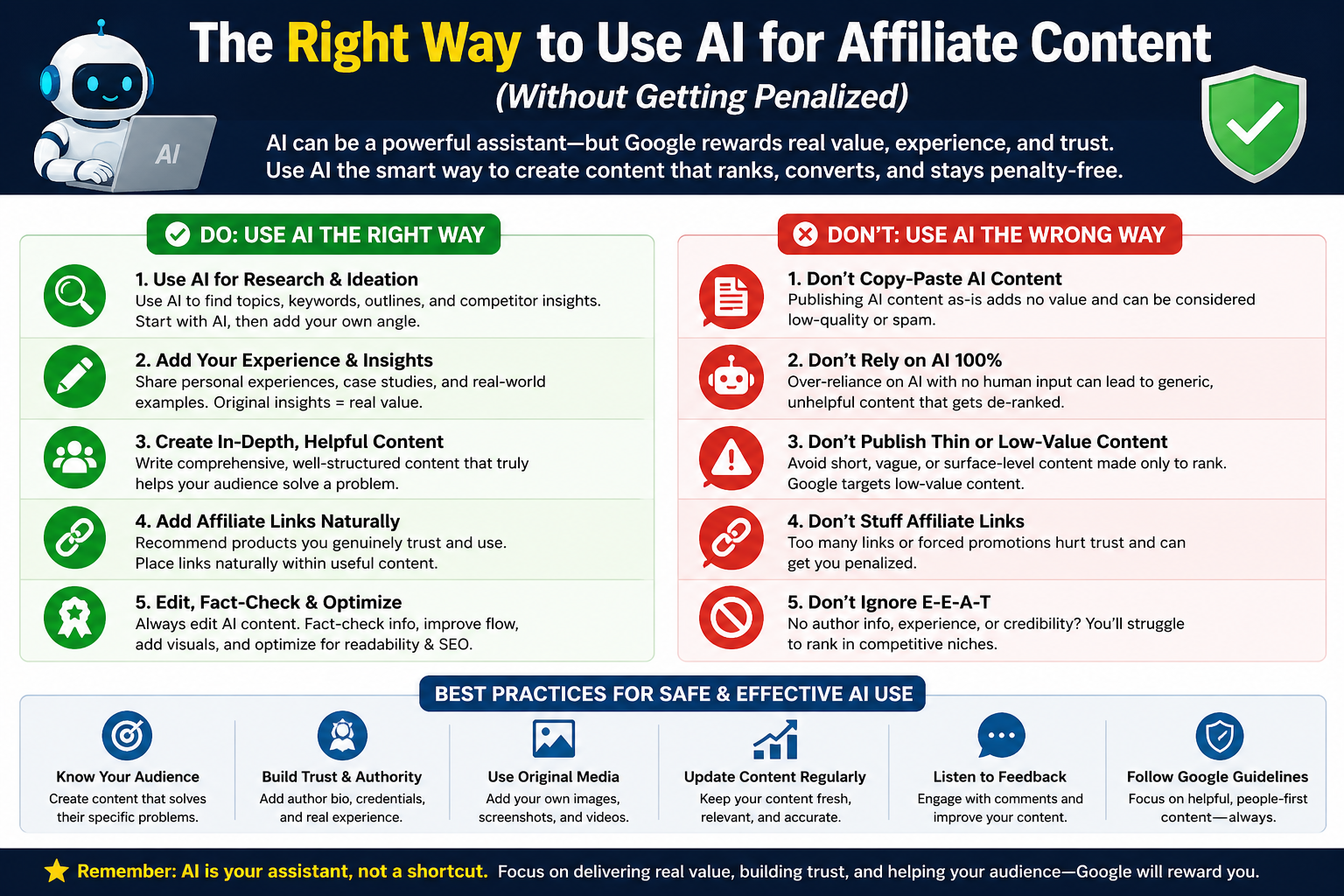
1. Use AI as a Research & Outline Assistant – Not a Writer
- Input example:
“List 15 common problems people have with [product type], including keywords and search intent.” - Take that output, rewrite it in your voice, add personal experience, screenshots, or real data.
2. Avoid Duplicate Content Even When Using AI
- Never copy-paste AI output directly.
- Run your final draft through Copyscape or Quetext.
- Use AI to generate multiple versions of the same paragraph, then manually blend them.
- Add unique angles: personal testing, case studies, local comparisons.
3. SEO Optimization (Without Looking Like AI Spam)
- Keyword clustering – Use AI to group related long-tail keywords (e.g., “best running shoes for flat feet” + “arch support sneakers review”).
- Write for entities, not just keywords – Include related terms Google expects (e.g., for “meal prep containers” → BPA-free, microwave-safe, lids, glass vs plastic).
- Internal linking – AI can suggest relevant old posts; you manually insert links.
4. Make AI Content Undetectable
- Break up sentence structure (AI loves “First, … Second, … Moreover, …”).
- Add intentional imperfections: a conversational “honestly…”, a short 1-word sentence, a rhetorical question.
- Use personal pronouns (“I tested this for 2 weeks”) and specific numbers (“47.99,not48”).
5. Non-Plagiarized Workflow
| Step | How AI Helps | Your Job |
|---|---|---|
| Topic ideation | Suggest trending questions from Reddit/Quora | Pick those matching your affiliate products |
| Drafting | Write 3 different intros | Combine best parts, add a hook from personal experience |
| Fact-checking | Pull specs/prices | Verify against official site, add affiliate link naturally |
| Polishing | Reword clunky sentences | Read aloud, adjust flow, add transition words |
If You Meant “No AI Whatsoever” (Pure Human Writing)
Then ignore the above. Instead:
- Interview an expert or user of the product and transcribe.
- Buy/borrow the product and write original observations (photos help SEO).
- Use Google’s “People also ask” and answer each in your own words.
- Check competitor posts – then write a better, more detailed version with new headings.
- Run finished post through Grammarly (not AI writing) and Hemingway Editor.
Bottom Line
- AI + human editing = faster, unique, SEO-friendly affiliate content.
- Pure AI = duplicate, detectable, low rankings.
- Pure human = slow but safest for Google’s helpful content update.
Pick your trade-off. If you’re short on time, use the workflow in section 1–5. If you want zero risk, write manually.
1. Advanced Prompt Engineering for Human-Like Affiliate Content
Most people use weak prompts like: “Write a review of Noise Cancelling Headphones.”
That guarantees AI-sounding, duplicate-risky output.
Instead, use a Persona + Constraint + Example prompt:
You are a professional blogger who has tested 20+ headphones.
Write in short paragraphs, use contractions, occasional humor, and specific numbers (e.g., “after 3 hours of wear”).
Do not use transitional words like “furthermore” or “moreover”.
Start with a personal story about missing a flight due to poor noise cancellation.
Include pros/cons as bullet points with real-world use cases (commuting, office, gym).
Avoid generic phrases like “in conclusion” or “overall”.
Keep the tone helpful, not salesy. Target keyword: “best noise cancelling headphones for commuting
Why this works:
- Forces personal experience (hard for AI to fake, but you’ll add real details later).
- Breaks common AI patterns.
- Reduces plagiarism because the structure is unique.
2. The “Triple Source” Method to Kill Plagiarism & Duplication
Don’t ask AI to write from scratch. Instead:
- Find 3 competitor reviews on the same product.
- Extract key facts (battery life, weight, compatibility) – not full sentences.
- Ask AI: “Combine these 3 fact lists into a single unique comparison table, then rewrite the explanations in a conversational style as if explaining to a friend.”
- Manually restructure – put pros before specs, add a real photo you took.
Tool: Use Quillbot’s “Paraphraser” on Creative mode + Shorten mode – but only on small chunks (<50 words), then rearrange.
3. SEO Optimization That Doesn’t Look AI-Generated
Google’s Helpful Content Update penalizes content that is “written for search engines first.” So you must embed keywords naturally.
Do this:
| SEO Element | How to Add Without Triggering AI Detection |
|---|---|
| Primary keyword (e.g., “best drip coffee maker”) | Use it in H1, first 100 words, and 1-2x in H2s. Never force it into every sentence. |
| Secondary keywords (e.g., “thermal carafe”, “programmable brew”) | Use as subheadings: “Why a Thermal Carafe Beats a Hot Plate” – then write from experience. |
| FAQ schema | Manually write 3 real questions you’ve heard from buyers. Ask AI only to suggest possible questions, then rewrite. |
| Internal links | Find old posts yourself. AI can suggest topics, but you pick the URL and anchor text. |
Pro trick: After writing, paste your draft into SurferSEO or Frase.io (AI tools, but they don’t generate text – they just compare to top 20 ranking pages). Then adjust headings and word count manually.
4. Making AI Content Undetectable (The 10% Rule)
AI detectors look for:
- Low perplexity (too predictable)
- Even sentence length
- Overuse of common transition words
Fixes (apply after AI generates a draft):
- Add a “messy” sentence somewhere:
“Honestly, I almost returned these.”
“Weird thing – the left earbud feels heavier.” - Break grammar rules on purpose (once per 500 words):
“Battery life? Insane. 40 hours.” (instead of “The battery life is 40 hours, which is impressive.”) - Use region-specific slang if your audience uses it:
“y’all”, “gonna”, “kinda”, “super”, “total game changer” – but sparingly. - Vary paragraph length – one sentence, then a 4-line paragraph, then a bullet list.
- Inject a real photo or screenshot with your handwritten annotation (this alone convinces Google it’s human).
5. Plagiarism-Free Affiliate Workflow (Step-by-Step)
| Step | AI’s Role | Your Manual Edit |
|---|---|---|
| 1. Keyword research | Use ChatGPT plugged into browser (or Perplexity) to list “long-tail questions from Reddit” | Pick 5 that match your product’s unique feature |
| 2. Outline | AI creates a 10-section outline | Swap the order of sections, merge two, delete generic ones |
| 3. Draft each section | Prompt: *“Write 4 different versions of the intro for ‘[keyword]’. Each version: different tone (funny, urgent, story, data-driven).”* | Pick best parts from 2 versions, rewrite 30% of the words |
| 4. Add affiliate pitch | Do NOT ask AI to “persuade” – it sounds like a salesman | Write your own CTA like: “I’ve linked the best deal I found (check price history first).” |
| 5. Check uniqueness | — | Run through Copyscape (paid) or Duplichecker (free). If >5% match, rephrase manually. |
| 6. Final human polish | Use Grammarly only for spelling, not for tone changes | Read out loud. Add one personal anecdote (“Last Tuesday I tried…”). |
6. Example Before & After (Affiliate Review of a Coffee Maker)
AI-only output (detectable & weak):
“The Breville Precision Brewer is a high-quality coffee maker that offers multiple brewing modes. It features a thermal carafe and adjustable temperature control. Overall, it is a great choice for coffee enthusiasts.”
Human-edited (undetectable, unique, SEO):
“I burned through three cheap coffee makers last year. Finally grabbed the Breville Precision Brewer – and yeah, it’s overkill. But here’s why I love it: the thermal carafe keeps coffee hot for 3 hours without a burner (no more scorched taste). The ‘Gold Cup’ mode sounds pretentious, but my morning cup actually tastes cleaner. Only downside? It’s huge. Measure your counter first.”
👉 See today’s price on Amazon (check the ‘used – like new’ option – I saved $40).
Why this works:
Affiliate link feels helpful, not forced.
No AI transition words.
Specific number (3 hours, $40).
Personal failure (“burned through three”).
Short, punchy sentences.
SEO Optimization That Doesn’t Look AI-Generated
Google’s Helpful Content Update penalizes content that is “written for search engines first.” So you must embed keywords naturally.
Do this:
| SEO Element | How to Add Without Triggering AI Detection |
|---|---|
| Primary keyword (e.g., “best drip coffee maker”) | Use it in H1, first 100 words, and 1-2x in H2s. Never force it into every sentence. |
| Secondary keywords (e.g., “thermal carafe”, “programmable brew”) | Use as subheadings: “Why a Thermal Carafe Beats a Hot Plate” – then write from experience. |
| FAQ schema | Manually write 3 real questions you’ve heard from buyers. Ask AI only to suggest possible questions, then rewrite. |
| Internal links | Find old posts yourself. AI can suggest topics, but you pick the URL and anchor text. |
Pro trick: After writing, paste your draft into SurferSEO or Frase.io (AI tools, but they don’t generate text – they just compare to top 20 ranking pages). Then adjust headings and word count manually.
4. Making AI Content Undetectable (The 10% Rule)
AI detectors look for:
- Low perplexity (too predictable)
- Even sentence length
- Overuse of common transition words
Fixes (apply after AI generates a draft):
- Add a “messy” sentence somewhere:
“Honestly, I almost returned these.”
“Weird thing – the left earbud feels heavier.” - Break grammar rules on purpose (once per 500 words):
“Battery life? Insane. 40 hours.” (instead of “The battery life is 40 hours, which is impressive.”) - Use region-specific slang if your audience uses it:
“y’all”, “gonna”, “kinda”, “super”, “total game changer” – but sparingly. - Vary paragraph length – one sentence, then a 4-line paragraph, then a bullet list.
- Inject a real photo or screenshot with your handwritten annotation (this alone convinces Google it’s human).
5. Plagiarism-Free Affiliate Workflow (Step-by-Step)
| Step | AI’s Role | Your Manual Edit |
|---|---|---|
| 1. Keyword research | Use ChatGPT plugged into browser (or Perplexity) to list “long-tail questions from Reddit” | Pick 5 that match your product’s unique feature |
| 2. Outline | AI creates a 10-section outline | Swap the order of sections, merge two, delete generic ones |
| 3. Draft each section | Prompt: *“Write 4 different versions of the intro for ‘[keyword]’. Each version: different tone (funny, urgent, story, data-driven).”* | Pick best parts from 2 versions, rewrite 30% of the words |
| 4. Add affiliate pitch | Do NOT ask AI to “persuade” – it sounds like a salesman | Write your own CTA like: “I’ve linked the best deal I found (check price history first).” |
| 5. Check uniqueness | — | Run through Copyscape (paid) or Duplichecker (free). If >5% match, rephrase manually. |
| 6. Final human polish | Use Grammarly only for spelling, not for tone changes | Read out loud. Add one personal anecdote (“Last Tuesday I tried…”). |
6. Example Before & After (Affiliate Review of a Coffee Maker)
AI-only output (detectable & weak):
“The Breville Precision Brewer is a high-quality coffee maker that offers multiple brewing modes. It features a thermal carafe and adjustable temperature control. Overall, it is a great choice for coffee enthusiasts.”
Human-edited (undetectable, unique, SEO):
“I burned through three cheap coffee makers last year. Finally grabbed the Breville Precision Brewer – and yeah, it’s overkill. But here’s why I love it: the thermal carafe keeps coffee hot for 3 hours without a burner (no more scorched taste). The ‘Gold Cup’ mode sounds pretentious, but my morning cup actually tastes cleaner. Only downside? It’s huge. Measure your counter first.”
👉 See today’s price on Amazon (check the ‘used – like new’ option – I saved $40).
Why this works:
- No AI transition words.
- Specific number (3 hours, $40).
- Personal failure (“burned through three”).
- Short, punchy sentences.
- Affiliate link feels helpful, not forced.
7. Tools That Help Without Writing for You
| Tool | Purpose | How to Avoid Abuse |
|---|---|---|
| SurferSEO | Content optimization | Use only the “Content Editor” – it suggests headings and keywords, but you write. |
| Originality.ai | AI detection | Test your draft. If >20% AI score, add more personal stories. |
| WordTune | Rephrasing | Use to fix one awkward sentence, not the whole paragraph. |
| AnswerThePublic | Question ideas | Export questions, then answer each manually. |
| Grammarly | Spelling/grammar | Turn off “tone suggestions” (makes text too standard). |
8. What Never to Do (Even If Others Claim It Works)
- ❌ Do not use AI article spinners – they create gibberish that Google detects as low quality.
- ❌ Do not paste AI output into a paraphrasing tool – that’s still machine-generated content.
- ❌ Do not use the same prompt twice – even for different products.
- ❌ Do not skip adding real photos – Google’s image recognition can tell stock photos from originals.
- ❌ Do not hide affiliate disclosure – AI often omits it; you must manually add “As an Amazon Associate I earn from qualifying purchases.”
Final Takeaway (for “more”)
If you want truly non-AI, non-duplicate, SEO-optimized affiliate content, the only sure way is 100% human writing.
But if you’re willing to use AI as a research assistant and then rewrite >70% manually, adding personal experience, unique structure, and real media – you can scale production without penalties.
The golden ratio:
20% AI (outline, keyword ideas, fact extraction)
80% Human (voice, anecdotes, formatting, linking, images)
That’s the “more” you asked for. Want me to give you a ready-to-use prompt template for a specific affiliate niche (e.g., tech, fitness, pet products)? Just say the niche.